

On this page
- Which Semgrep alternative fits your reason to leave?
- What does Semgrep Community Edition leave out?
- Is Opengrep a drop-in replacement for Semgrep?
- Which alternatives check code written by AI coding agents?
- How do the alternatives price, compared with Semgrep?
- Where does each alternative keep your code and findings?
- When should you stay on Semgrep?
- How do you move off Semgrep without losing your rules?
- Where does CybeDefend fit?
- Frequently asked questions
- What is the best free alternative to Semgrep?
- Can Opengrep run Semgrep rules?
- Does Semgrep Community Edition do cross-file analysis?
- Is SonarQube a good alternative to Semgrep?
- What are the alternatives to Semgrep Guardian?
- Where does Semgrep store customer data?
- Is CodeQL a free alternative to Semgrep?
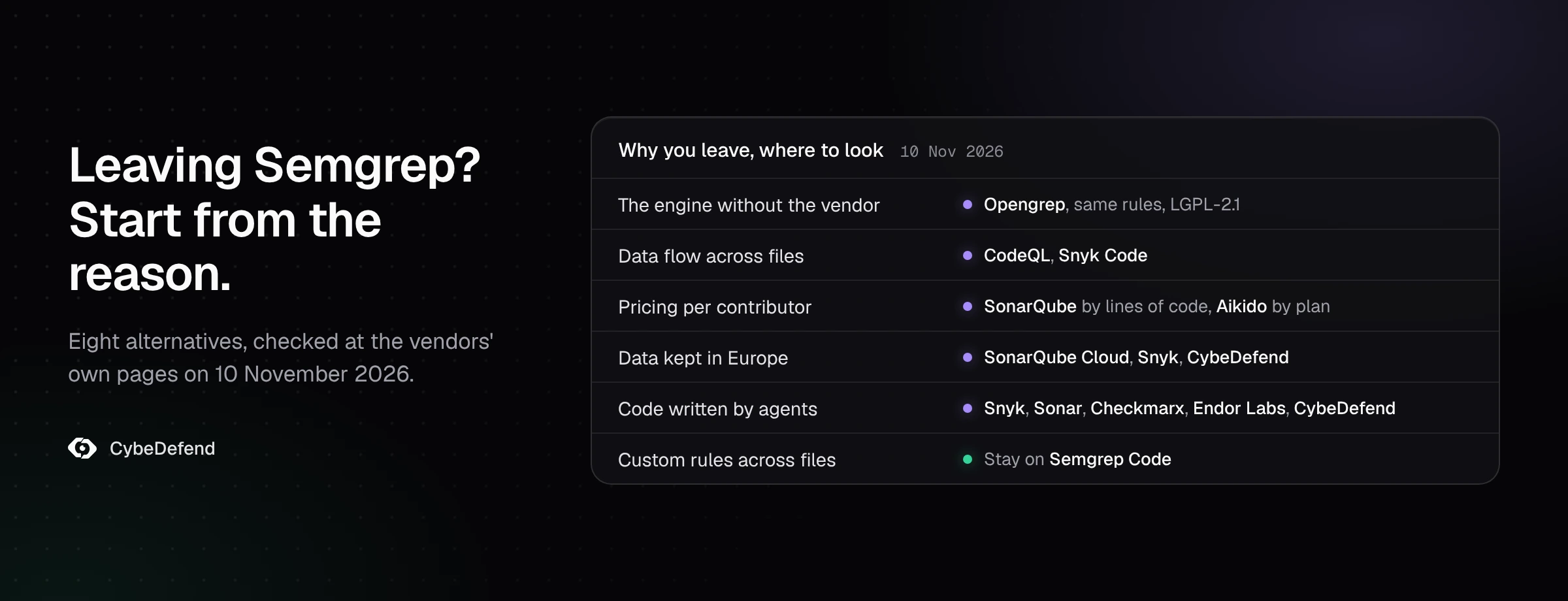
The best Semgrep alternative depends on why you are leaving Semgrep. We checked eight of them at the vendors' own pages on 10 November 2026; for the free engines alone, our guide to open-source SAST tools compares twenty. The reasons sort the field. To keep the open-source engine without the company, Opengrep runs your Semgrep rules unchanged. For data flow across files without Semgrep's paid tier, CodeQL and Snyk Code do it. To stop paying per contributor, SonarQube prices by lines of code and Aikido by plan. To keep your data in Europe, SonarQube Cloud, Snyk Enterprise and CybeDefend offer an EU region, where Semgrep stores customer data in AWS in the US. And for code written by AI coding agents, Snyk, SonarQube, Checkmarx, Endor Labs and CybeDefend now run inside the agent, as Semgrep Guardian does.
Which Semgrep alternative fits your reason to leave?
Start from the reason, not from a list of logos. Each row below names what made teams look elsewhere, the tools that answer it, and what they give in exchange.
| Why you are leaving | Look at | What you get |
|---|---|---|
| You want the engine without the vendor | Opengrep | The same rule syntax under LGPL-2.1, maintained in the open with the backing of several AppSec vendors |
| Community Edition stops at one file or function | CodeQL in GitHub Code Security, Snyk Code | Data flow across files, inside a commercial product |
| Pricing per contributor grows with the team | SonarQube, Aikido | A price by lines of code, or a fee per plan that includes a number of users |
| Your code and findings must stay in Europe | SonarQube Cloud, Snyk Enterprise, CybeDefend, or a self-hosted engine | An EU region, or nothing leaving your machines |
| Agents write the code now | Snyk Studio, SonarQube's agent plugins, Checkmarx Developer Assist, Endor Labs AURI, CybeDefend VibeDefend | Checks inside the agent session, as Semgrep Guardian does |
| You want one platform for code, dependencies, containers and IaC | Snyk, Aikido, Checkmarx, CybeDefend | One queue for every scanner, with container images included |
The first three reasons come from Semgrep's own terms, which the next section reads line by line.
What does Semgrep Community Edition leave out?
The free engine reads one file at a time. Semgrep's own comparison says Community Edition "provides cross function constant propagation and single function taint analysis", and that "it can't track data beyond a single function or file and may find more false positives." Cross-file analysis is part of the paid Semgrep Code, which Semgrep's FAQ calls "proprietary cross-file (interfile) analysis". Community Edition also has no triage, tuning, metrics or reporting: at scale, deploying it and sending its findings anywhere is manual work.
Three more facts drive the search for alternatives:
- The rules are not open source. The engine is LGPL-2.1, but every rule Semgrep maintains is under the Semgrep Rules License v1.0, which Semgrep itself says "is not an open source license". Vendors may not use those rules in competing products or SaaS offerings. Rules from third-party repositories in the registry keep their own licences.
- The price follows your contributors. The Free Edition covers up to 10 contributors. Beyond that, Teams is priced per contributor, per month, per product (Code, Supply Chain, Secrets). A contributor is anyone who committed to a scanned private repository in the past 90 days.
- The data sits in the US. Semgrep's FAQ states that "All customer data is located in AWS (US region)."
None of this makes Semgrep a bad tool. It explains why a team that started on the free engine meets a decision once it grows, and why the answers differ.
Is Opengrep a drop-in replacement for Semgrep?
For the engine, mostly yes. Opengrep is a fork of Semgrep under the same LGPL-2.1 licence; its README says it "was created when Semgrep moved critical features behind a commercial licence". It reads the same rule syntax, so your own rules run as they are:
# your existing rules, results in SARIF for CI or a security platform
opengrep scan --sarif-output=opengrep.sarif -f ./rules .
What it adds, compared with Semgrep Community Edition:
- Taint across functions inside a file, with
--taint-intrafile. Semgrep's equivalent,--pro-intrafile, is a paid Semgrep Code capability. - More languages. Semgrep's own comparison lists Crystal, Visual Basic and Apex on Opengrep's side; Opengrep's maintainers add Elixir.
- Packaging. Self-contained binaries with no Python runtime, signed with Cosign.
- Cross-file taint, in testing. The pre-release
v2.0.0-nopython-interfileof 11 September 2026 adds.alpha.3 --taint-interfile, marked "FOR TESTING ONLY". The latest stable release is 1.30.0, of 7 September 2026.
What it does not do: it publishes no ruleset of its own, so new vulnerability classes are yours to cover; it has no dependency or secrets scanning; it runs from the command line only, with no dashboard or triage. Semgrep also notes that the two command lines "remain similar, though individual arguments have diverged", so check your CI scripts.
The project is active. In its first year it shipped 43 releases and took 29 pull requests from 17 external contributors, according to a post by one of its three maintainers on Aikido's blog in May 2026. The backers named in its README are Aikido, Amplify, Endor Labs, Kodem and Orca Security.
Which alternatives check code written by AI coding agents?
Semgrep's answer is Guardian, a plugin that bundles "an MCP server, hooks, and skills", where "hooks fire on every file write". It names Claude Code, Cursor and Devin Desktop (still listed as Windsurf), added OpenAI Codex in October 2026 "with the same capabilities as Claude Code", and has a GitHub Copilot version in early access. New Semgrep organizations can try it free for 30 days.
Five alternatives now do the same kind of work. As each vendor documents it on 10 November 2026:
| Tool | Agents the vendor names | How it plugs in | What stands out |
|---|---|---|---|
| Snyk Studio | Claude Code, Cursor, Codex CLI, Gemini CLI, GitHub Copilot | Hooks, its MCP server for other agents | Code, dependency, container and IaC scans as agent tools |
| SonarQube | Claude Code; plugins also listed for Cursor, Codex, Google Antigravity and the Copilot CLI | Skills, agents, hooks and an MCP server | Analysis after each file edit with Agentic Analysis, in beta for C#, Java, JavaScript, Python and TypeScript; over 450 secret patterns blocked before they reach the model |
| Checkmarx Developer Assist | Cursor, Devin Desktop, Kiro; CLI plugins for Claude Code, Copilot, Cursor, Gemini and Codex | IDE extension, CLI plugins | Detects, fixes and "verifies it before code is committed" |
| Endor Labs AURI | Cursor, Claude Code, OpenAI Codex, OpenHands | Skills plugin, MCP server, CLI | Code, secrets, dependencies and container images; free for everyone |
| CybeDefend VibeDefend | Claude Code, Cursor, OpenAI Codex, Google Antigravity, Devin Desktop, GitHub Copilot | One install command, hooks and MCP | Serves your team's business and security rules while the agent writes, and refuses dangerous commands before they run |
They differ in when they act and on what. Every tool in the table checks code once it is written: a file, an edit, a diff. Two of them also act on what the agent does. VibeDefend's guards check every tool call in Claude Code, Cursor, OpenAI Codex and Google Antigravity, and block file writes, file reads and shell commands in Devin Desktop; Snyk's Agent Behavior Governance evaluates each agent action against a policy before it runs. For the wider field, our comparison of the best AI code security tools by need goes further.
How do the alternatives price, compared with Semgrep?
By different units, which matters more than the list price. A team that pays per contributor pays for headcount; a team that pays by lines of code pays for the size of what it ships. Here is what each vendor counts, as published on 10 November 2026:
| Tool | What you pay for | Free to start |
|---|---|---|
| Semgrep | Each contributor, per product, per month | Up to 10 contributors |
| Opengrep | Nothing, LGPL-2.1 | All of it |
| SonarQube | Lines of code: a maximum on Cloud, per instance on Server | Community Build, self-hosted; Cloud up to 50k private lines |
| GitHub Code Security | Each active committer, per month, also on the GitHub Team plan | The CodeQL CLI on open-source code |
| Snyk | Each contributing developer, per product | A limited number of tests |
| Aikido | A fee per plan that includes a number of users | 2 users, 10 repositories |
| Checkmarx, Endor Labs | On request | Endor Labs AURI is free |
| CybeDefend | Per seat in our cloud; VibeDefend billed on usage | The open source edition, free to self-host; VibeDefend's free tier |
Count before you compare. Semgrep, Snyk and GitHub all count the people who committed over the last 90 days, contractors and occasional contributors included, so that number is the one to bring to every quote. Our breakdown of what AI code security costs puts these units next to the hours a finding costs to fix.
Where does each alternative keep your code and findings?
If data residency is your reason to leave, this is the short list, from each vendor's documentation:
- Semgrep: AWS, US region, for all customer data.
- SonarQube Cloud: EU region by default; a US region on the Team (annual) or Enterprise plan. The region is chosen at sign-up and cannot be changed.
- Snyk: US, EU (Frankfurt) and Australia, plus a US government region; regional hosting "only for Enterprise plans".
- CybeDefend: Europe on SecNumCloud-qualified infrastructure, or a US region, chosen at sign-up; on premises or air-gapped for Enterprise.
- Self-hosted: Opengrep, SonarQube Community Build or Server, and the CodeQL CLI run on your machines, so the code never leaves them. The CodeQL CLI still needs a paid licence for private code.
When should you stay on Semgrep?
Stay if your security team writes its own rules and needs them to follow data across files. Semgrep Code's cross-file engine reads those rules today; Opengrep's cross-file mode is a test release, and every other engine here would mean rewriting them in its own language. Stay too if you already rely on Semgrep Assistant's triage, Supply Chain and Guardian, and US hosting suits you. A move costs rules, CI changes and a few weeks of side-by-side findings, so it should buy something you named in the first table.
How do you move off Semgrep without losing your rules?
Treat it as a migration of rules first and of tools second.
- Sort your rules by owner. Rules your team wrote are yours. Third-party rules in the registry keep their own licences. Rules Semgrep maintains are under the Semgrep Rules License v1.0: read it before you reuse them inside a product of your own.
- Run both engines on pull requests for two weeks. Write SARIF from each and compare what they find on the same commits.
- Gate on new findings only. A baseline keeps the switch from flooding the queue with old results; our article on sorting the SAST findings that are noise covers the triage that follows.
- Keep one queue. If you run a multi-language engine with a specialist per language, merge their SARIF in one place, as our guide to running several open-source SAST tools together shows.
Where does CybeDefend fit?
CybeDefend runs SAST, SCA, secrets, IaC, container and CI/CD scanning in one place and sorts the findings by reachability, so the ones on top are the ones an attacker can reach. It also runs the SARIF scanners you choose, Opengrep included, in the same deduplicated queue, so leaving Semgrep's platform does not mean leaving your rules. Data stays in Europe on SecNumCloud-qualified infrastructure, or in a US region. When coding agents write the code, VibeDefend hands them your rules and the findings while they write, before the pull request. The open source edition, free to self-host, has its waitlist open.
Frequently asked questions
What is the best free alternative to Semgrep?
Opengrep, if you want the same engine: it is LGPL-2.1, runs Semgrep rules unchanged and adds taint tracking across functions inside a file. SonarQube Community Build is the free self-hosted option with its own rules. Pair either with a specialist for your main language, such as Bandit for Python or gosec for Go.
Can Opengrep run Semgrep rules?
Yes. Both engines read the same rule syntax, so rules your team wrote run as they are. Some command-line arguments differ, so check your CI scripts. Rules that Semgrep maintains are under the Semgrep Rules License v1.0, which is not an open-source licence, and Opengrep ships no ruleset of its own.
Does Semgrep Community Edition do cross-file analysis?
No. Community Edition tracks taint within a single function and cannot follow data beyond one function or file. Cross-file analysis is part of the paid Semgrep Code. Opengrep has it in a test release, and CodeQL and Snyk Code trace data across files in their commercial products.
Is SonarQube a good alternative to Semgrep?
For a team that wants code quality and security in one tool, yes. Its core covers SAST and secrets detection; dependency scanning comes with Advanced Security, sold from the Team plan. SonarQube Cloud is priced by lines of code, hosted in the EU by default, and its plugins check code inside Claude Code and other agents. Custom rules do not carry over from Semgrep.
What are the alternatives to Semgrep Guardian?
Snyk Studio, SonarQube's agent plugins, Checkmarx Developer Assist, Endor Labs AURI and CybeDefend VibeDefend all run inside AI coding agents. They differ on the agents they support, on when they check (each file write, each edit, before the commit) and on whether they also act on the agent's commands, as VibeDefend's guards do.
Where does Semgrep store customer data?
In Amazon Web Services, US region, according to Semgrep's FAQ. Teams that need data in Europe look at SonarQube Cloud's EU region, Snyk's Frankfurt region on Enterprise plans, CybeDefend's SecNumCloud-qualified hosting in Europe, or a self-hosted engine.
Is CodeQL a free alternative to Semgrep?
Only for open-source code. The CodeQL queries are MIT-licensed, but the CodeQL CLI ships under GitHub's own terms: free for research and open-source code, while private code needs GitHub Code Security, priced per active committer. Its global data flow analysis follows data across the whole program.