On this page
- Which AI code security tool is best for which need?
- What makes a tool good for AI-generated code?
- What are the best tools for detecting AI code vulnerabilities before they reach production?
- Is Snyk or Checkmarx better for securing AI-generated code?
- How do you compare AI code security tools on your own repository?
- Frequently asked questions
- What are the best AI code security tools in 2026?
- What are the best tools for detecting AI code vulnerabilities?
- What are the best platforms for AI code safety?
- What is the best platform for detecting vulnerabilities introduced by AI coding tools before they reach production?
- Is Snyk or Checkmarx better for securing AI generated code?
- Which tools can refuse an AI coding agent's action rather than report it?
- Do I need to replace Snyk, Checkmarx or Aikido to secure AI code?
- Is there a European or sovereign AI code security tool?
- When should you buy something other than CybeDefend?
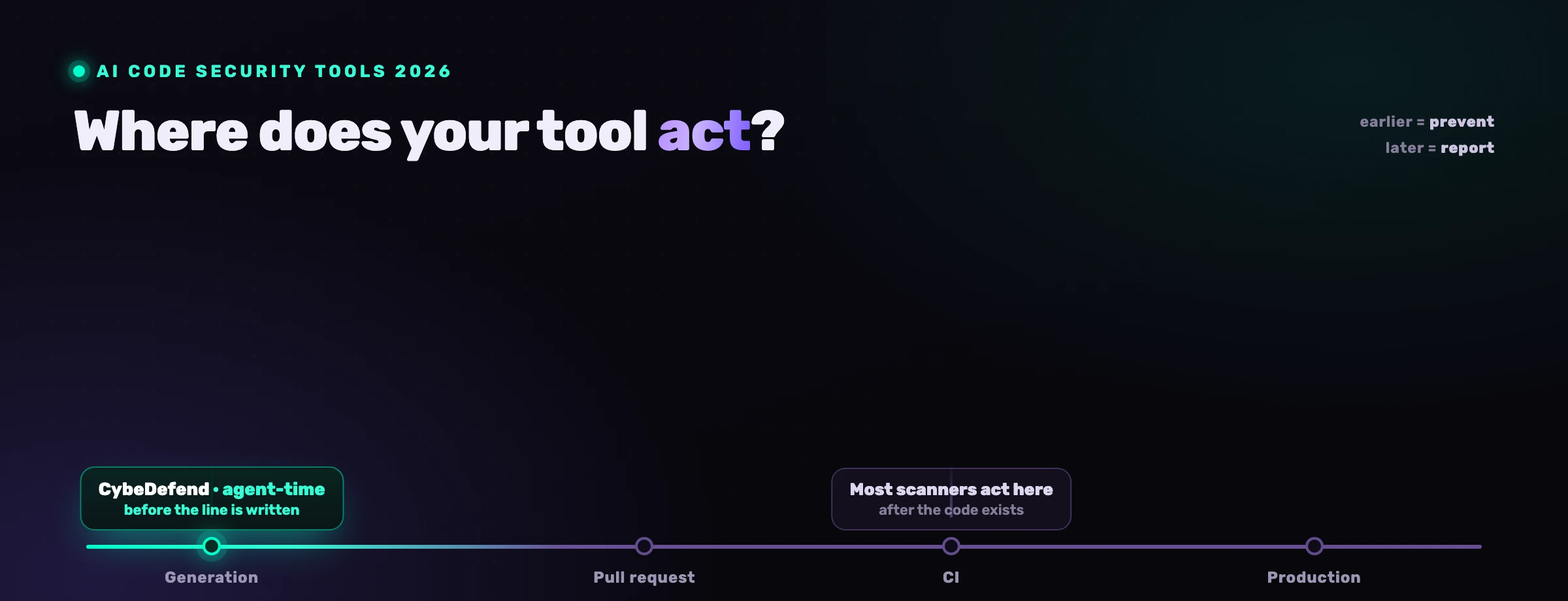
The best AI code security tool depends on where you need security to act. If an agent writes most of your code, you need a tool that checks the change while it is written; if your bottleneck is dependencies, secrets, governance or cloud context, a specialist wins. The table answers that first, the criteria, the field and the evidence follow.
Which AI code security tool is best for which need?
Pick by bottleneck, not by brand. For code an AI agent writes, shortlist the tools that run inside the agent (CybeDefend, Endor Labs, Snyk, Semgrep, Checkmarx). For dependency risk, reachability-led SCA (Endor Labs, Snyk). For secrets, GitGuardian. For central governance, Checkmarx or Veracode. For a team already on GitHub or GitLab, the native add-on is the cheapest first step.
| Your need | Shortlist | Where it acts |
|---|---|---|
| Stop insecure code while an AI agent writes it, and refuse dangerous agent actions | CybeDefend (VibeDefend), Endor Labs | Inside the agent session, before the save |
| Check every file an agent generates, then gate the PR | Snyk, Semgrep, Checkmarx, SonarQube, Aikido | Agent hooks or MCP, then PR and CI |
| Broad developer-first coverage: code, dependencies, containers, IaC | Snyk, Aikido | IDE, PR, CI |
| Enterprise governance, policy and compliance reporting | Checkmarx, Veracode | PR, CI, central dashboard |
| Rules you write and can read yourself | Semgrep | IDE, PR, CI |
| Dependency reachability, transitive risk | Endor Labs, Snyk | PR, CI |
| Secrets and machine identities | GitGuardian | Pre-commit, CI, agent tools |
| Zero integration work, already in the bill | GitHub Advanced Security, GitLab Ultimate | Native in the platform's PR and pipeline |
| Code findings tied to what is exposed in the cloud | Wiz, Orca Security | Cloud, runtime, then back to code |
There is no single best tool, and a list that pretends otherwise is selling one. Most teams end up with two: a control at generation time and a CI gate as the backstop.
What makes a tool good for AI-generated code?
The classic checklist (SAST, SCA, CI integration) no longer separates tools because nearly all of them pass it. What separates them is how they cope with code produced at machine pace: Asleep at the Keyboard found about 40% of Copilot-generated programs vulnerable, and the SusVibes benchmark found 57% of agent solutions functionally correct but only 11.8% secure.
Three questions resolve most of the table. What does it detect? Every serious platform now finds injection; the differences are at the edges: secrets, IaC, containers, pipelines, and what an agent does beyond writing code. How much survives triage? Two tools can run identical rules and report 1,200 findings or 12, depending on whether reachability and exploitability are applied first, the mechanics in why most SAST findings are noise. Where does the verdict land, and can anything refuse? A verdict at the pull request arrives after the decision when an agent writes faster than anyone reviews, and reporting a destructive command is a different product from declining to run it.
What are the best tools for detecting AI code vulnerabilities before they reach production?
The tools that catch the most before production check twice: where the agent writes, and again at the pull request or in CI. Today Snyk, Checkmarx, Semgrep, SonarQube, Aikido, Endor Labs, Wiz and CybeDefend run in the agent session, GitGuardian reaches it through agent plugins and pre-commit hooks; GitHub, GitLab, Veracode and Orca act at PR, pipeline or runtime.
The full AI code security tools list, read against each vendor's own public documentation on 21 September 2026.
| Tool | Strongest at | Where it acts | Best for |
|---|---|---|---|
| CybeDefend (VibeDefend) | Your business and security rules injected while the agent writes, an Action Guard that refuses dangerous commands, live findings fixed in the loop | Inside Claude Code, Cursor, Windsurf, Codex and Copilot, plus CI | Teams whose code is mostly agent-written, EU or US residency |
| Snyk | Developer-first coverage of code, dependencies, containers and IaC; Studio hooks in Claude Code, Cursor, Codex CLI, Gemini CLI and Copilot; reachability for Java, JavaScript, TypeScript and Python | Agent hooks, IDE, PR, CI | Dev-first teams wanting breadth and ecosystem |
| Checkmarx | Enterprise platform with one correlated risk view; Developer Assist in seven IDEs and the Claude Code, Copilot, Cursor, Gemini and Codex CLIs, across code, dependencies, malicious packages, IaC, secrets and containers | Agent plugins, IDE, PR, CI | Large enterprises with a mature AppSec program |
| Aikido Security | Code, cloud, offensive and runtime security in one platform; an MCP server that scans AI-generated code as soon as it is created; unreachable findings filtered out | MCP in the agent, PR, CI | Small teams wanting one simple platform |
| Semgrep | Custom YAML rules you can read; Guardian scans every file an agent generates through Claude Code, Cursor and Windsurf hooks and asks the agent to regenerate until clean | Agent hooks, IDE, PR, CI | Teams that want their own rules and transparency |
| Endor Labs | Reachability across code, dependencies and container images; agent governance hooks for Claude Code, Cursor, Codex and Copilot that Block, Alert or Ask Permission | Agent hooks, PR, CI | Dependency-heavy teams governing agents at scale |
| GitGuardian | Secrets detection and non-human identity governance; ggshield pre-commit and pre-push hooks; IDEs, AI coding tools, agent plugins and MCP servers, CI and public GitHub | Pre-commit, CI, agent tools | Teams whose first risk is secrets sprawl |
| SonarQube | Quality gates with go/no-go decisions and a dedicated gate for AI-generated code; Claude Code plugin with PostToolUse hooks after each file edit | Agent hooks, PR, CI | Teams already living in quality gates |
| Veracode | Application risk management with governance, reporting and policy control; Veracode Fix in VS Code and IntelliJ, nothing merges without approval | IDE, PR, CI, central | Regulated environments where reporting is the deliverable |
| GitHub Advanced Security | Code Security (CodeQL, Copilot Autofix, dependency review) and Secret Protection (secret scanning, push protection) on Team or Enterprise plans; code from hosted Copilot, Claude and Codex agents validated before the PR is finalized | Native in the PR | GitHub-native teams |
| GitLab Ultimate | SAST, dependency scanning and secret detection inside the pipeline; agentic vulnerability resolution runs the pipeline to validate a fix and opens the merge request | Native in the pipeline | GitLab-native teams |
| Wiz | Code-to-cloud mapping from a cloud risk back to source; Claude Code and Cursor plugin scanning at file save, pre-commit and pre-push, warnings by default, block mode optional | Cloud, runtime, agent plugin | Cloud-first organizations |
| Orca Security | Agentless cloud coverage with SAST, SCA, secrets, IaC and container image scanning in code review and CI; MCP server invoked on demand from Cursor or VS Code | Cloud, PR, CI | Teams starting from cloud posture |
Head-to-head pages: Snyk, Checkmarx, Aikido, Semgrep, Endor Labs, SonarQube, Veracode, GitHub Advanced Security, GitLab Ultimate, Wiz and Orca Security.
Two things the table cannot show. "Runs in the agent" covers very different depths: some tools scan a file after the agent saves it, some can stop a commit or push, few evaluate an action before it runs. And none of the scanners above checks a change against the business rules your own team wrote, the class with no CWE described in business logic flaws in AI-generated code. That is the ground CybeDefend was built on, and why the pillar on AI coding agent security starts from the agent.
VibeDefend is the agent-time piece: a free npm CLI that installs in seconds and wires Claude Code, Cursor, Windsurf, OpenAI Codex and VS Code Copilot into four governance layers in the agent loop.
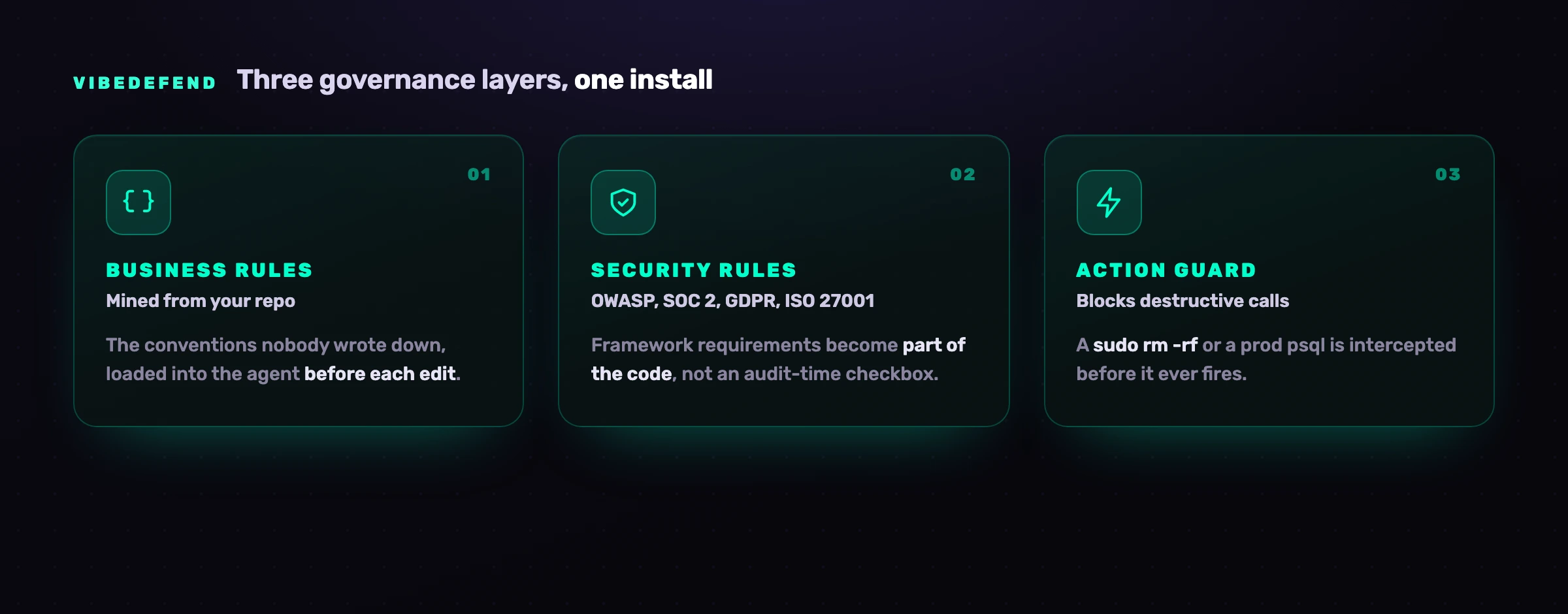
Business Rules and Security Rules govern what the agent writes, the Action Guard blocks destructive calls, and Live Findings wires the agent into the platform's SAST, SCA, secrets, IaC and CI/CD results so it fixes what you already have, the half covered in AI vulnerability remediation. The Action Guard decides locally, on the developer's machine, and analysis runs in the region you pick at install, EU or US, kept physically separate. None of this replaces a CI gate: generation-time prevention plus a CI backstop is the model in how to add security to your AI coding workflow.
Is Snyk or Checkmarx better for securing AI-generated code?
Snyk fits developer-first teams that want broad coverage across dependencies, code, containers and IaC with fixes in the IDE and the pull request. Checkmarx fits a large enterprise that needs one correlated risk view, central policy and depth across many teams. Both now check code inside AI coding agents, so the tie-breaker is your organisation, not the agent.
In the agent, as documented on 21 September 2026: Snyk Studio takes a hooks-based approach in Claude Code, Cursor, Codex CLI, Gemini CLI and GitHub Copilot so that AI-written code is checked at inception, with its MCP server as the fallback for other agents; reachability is generally available for Java, JavaScript, TypeScript and Python; and an Agent Behavior Governance capability that evaluates each agent action before it runs is in open preview. Checkmarx Developer Assist plugs into VS Code, JetBrains, Visual Studio, Eclipse, Cursor, Windsurf and Kiro and into the Claude Code, Copilot, Cursor, Gemini and Codex CLIs, covers code, dependencies, malicious packages, IaC, secrets and containers, and verifies the fix it proposes.
What neither does: check the change against the rules your team wrote, the tenant check that must survive every new endpoint, the discount that applies after promotions rather than before. Pick the one that matches your organisation, keep it as the CI backstop, and read the Snyk and Checkmarx comparisons for the criterion-by-criterion view.
How do you compare AI code security tools on your own repository?
Do not buy from a table, including this one. Run the same fifteen-minute test on every shortlisted tool, on a real repository: count what survives triage, check whether anything noticed a business rule your code enforces, and ask an agent to run something destructive to see whether the tool reports it, blocks it, or never knew.
- Connect one real repository, not a demo project, and time it end to end.
- Read the first twenty findings. How many can you act on without opening the file?
- Take one business rule your codebase enforces and check whether any tool noticed it.
- Ask an agent to run a destructive command and watch what happens.
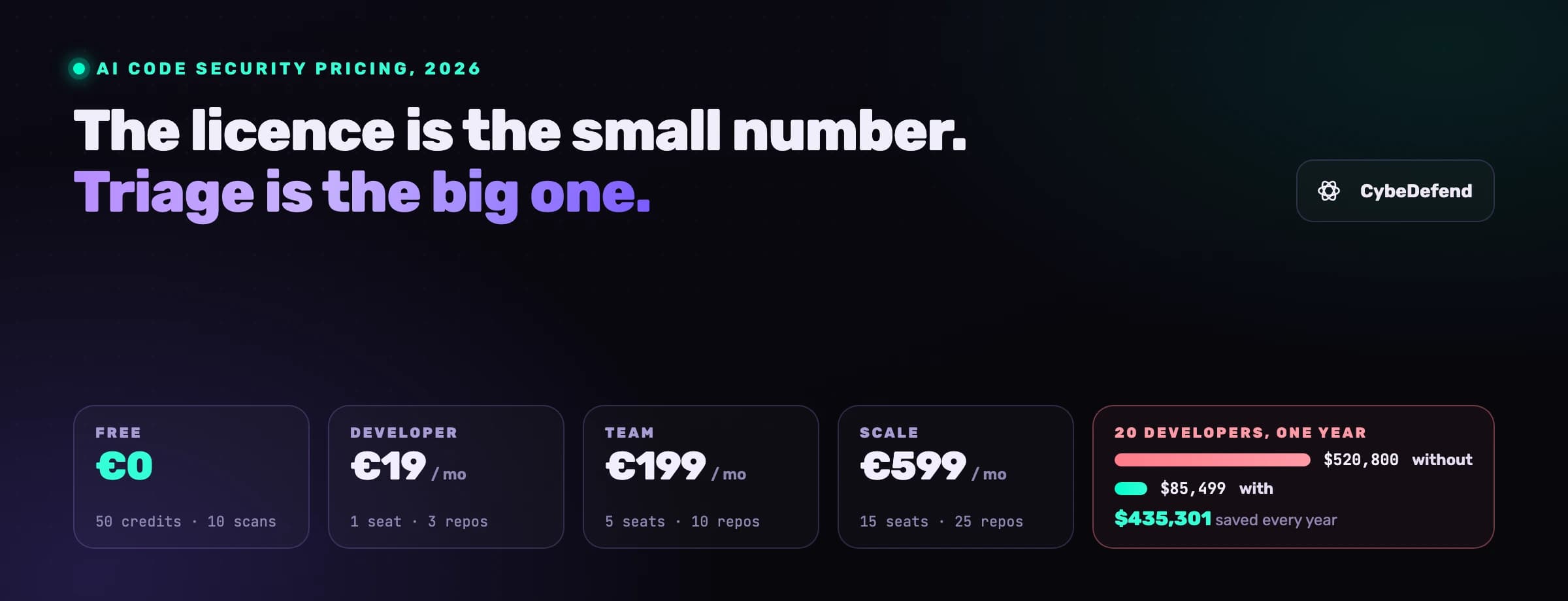
- Price it at twice your current headcount, and check which plan carries the EU region if you need one.
Steps three and four are the ones we can put numbers on. CybeDefend Research's controlled study of 24 August 2026 ran 30 developer tickets in three arms, 90 autonomous runs on Claude Opus 5 at effort high and 93 independent security scans, with the agent knowing the project's rules through nothing, a hand-maintained rules file, or injection at the moment of the edit.
rule specifics exact with the rule delivered at the edit (57 of 64), against 12% with no tool and 13% with a hand-maintained rules file
security findings introduced per task by an independent open-source scanner, against 0.10 with no tool; all of them fixed inside the task
shell commands refused by the action guards: 1 real credential reach, 3 policy-correct, 13 false positives
The limits are part of the result. On one task the arm with no tool beat VibeDefend because no channel delivered the rule that day; on another the rule was served thirteen times and the agent still dismantled its own safeguards, so injection informs, it does not enforce. Thirteen guard refusals were false positives. Six tasks ran degraded after an authentication failure and an MCP outage and were counted against the tool. The study measured codebases that started clean, not an existing backlog, and the layer's token overhead was $1.20 per ticket.
Frequently asked questions
What are the best AI code security tools in 2026?
Shortlist by bottleneck. For code an AI agent writes: CybeDefend, Endor Labs, Snyk, Semgrep or Checkmarx, all of which now run inside the agent session. For dependencies: Endor Labs or Snyk. For secrets: GitGuardian. For enterprise governance: Checkmarx or Veracode. For a GitHub or GitLab shop: the native security add-on first. For cloud context: Wiz or Orca.
What are the best tools for detecting AI code vulnerabilities?
The ones that check twice: in the agent, through hooks or an MCP server, and again at the pull request. Since about 40% of Copilot-generated programs in the Asleep at the Keyboard study were vulnerable, and since Broken Access Control still heads the OWASP Top 10:2025, weight reachability ranking and authorization coverage over raw rule count.
What are the best platforms for AI code safety?
For a small team, a consolidated platform such as Aikido or Snyk covers the most surface with the least rollout. For an enterprise, Checkmarx or Veracode add governance and reporting. For a team whose agents write most of the code, CybeDefend or Endor Labs add the layer the others lack: a control that acts before the save and can refuse an agent action.
What is the best platform for detecting vulnerabilities introduced by AI coding tools before they reach production?
One that acts at generation time and again in CI. At generation time, CybeDefend injects your rules into Claude Code, Cursor, Windsurf, Codex and Copilot and blocks dangerous commands; Snyk, Semgrep, Checkmarx, SonarQube and Endor Labs scan what the agent writes through hooks. In CI, any of them, or the GitHub and GitLab native scanners, serve as the backstop. NIST's SP 800-218A profile of the SSDF is the neutral reference for building that pipeline.
Is Snyk or Checkmarx better for securing AI generated code?
Neither is wrong. Snyk is the developer-first choice with hooks in five AI coding agents and reachability for Java, JavaScript, TypeScript and Python. Checkmarx is the enterprise choice with Developer Assist across seven IDEs and five agent CLIs. Pick by organisation, then pair it with a control that checks the change against your own business rules.
Which tools can refuse an AI coding agent's action rather than report it?
As of September 2026, three tools in this list document a control that evaluates a third-party coding agent's action before it runs: Endor Labs, whose governance hooks return Block, Alert or Ask Permission for Claude Code, Cursor, Codex and Copilot, and whose documentation notes that enforcement fails open if a hook cannot run; Snyk, whose Agent Behavior Governance is in open preview; and CybeDefend, whose Action Guard decides locally on the developer's machine. Wiz and GitHub can stop a commit or push, which is a later gate.
Do I need to replace Snyk, Checkmarx or Aikido to secure AI code?
Not necessarily. Many teams keep the scanner they trust as the CI gate and add agent-time enforcement in front of it, so the safe version is written first and the pipeline becomes the backstop. The question is whether your current tool acts early enough for agent cadence, and whether anything checks the change against your own rules.
Is there a European or sovereign AI code security tool?
Yes. CybeDefend is a French company with EU and US regions kept physically separate, chosen at install, the Action Guard running locally and analysis staying in the region you picked on models we host; the posture is GDPR compliance and a SOC 2 Type II audit under way. Several US vendors now offer an EU region too, often on enterprise tiers only, so check which plan carries it.
When should you buy something other than CybeDefend?
Three cases. If you need a formal attestation for a regulator today, the compliance-oriented incumbents have the longer track record with auditors. If your priority is cloud runtime posture, Wiz and Orca start from the right place and we do not. And if your code is mostly human-written at human cadence, agent-time enforcement solves a problem you do not have yet; buy on breadth or governance and read is AI-generated code safe when that changes.