


On this page
- What are the pricing models for AI code security tools in 2026?
- What does CybeDefend cost?
- What does a team actually pay per year?
- The two costs no pricing page shows
- Why the place a tool acts changes its price
- How to compare two quotes
- Is an AI code security tool worth it for a three-person startup?
- Frequently asked questions
- How much does an AI code security tool cost?
- What is the most cost-effective way to check AI-generated code for vulnerabilities?
- How much does SAST cost?
- Is there a free AI code security tool?
- What is the cheapest AI code security tool?
- Do I pay per seat or per repository?
- What does the CybeDefend free plan include?
- How is the ROI of a code security tool calculated?
- Does the price depend on which AI coding agent we use?
An AI code security tool costs anywhere between nothing and a five-figure annual contract, and the licence is rarely the biggest number on the invoice. This guide gives you the four pricing models you will meet in 2026 and what each one quietly bills for, CybeDefend's exact prices as a worked reference, what a solo developer, a five-person team and a twenty-developer organisation actually pay per year, and the two costs that never appear on a pricing page: the hours your developers spend fixing the rules an agent ignored, and the security findings that surface after merge because nobody caught them while the code was written.
What are the pricing models for AI code security tools in 2026?
There are four pricing models for AI code security tools in 2026: per developer seat, per contributing developer, platform tiers with add-ons, and usage-based billing on scans or credits. The differences weigh more on the invoice than the headline price does, and most vendors combine two of them, which is where the surprises at renewal come from.
| Model | What you are billed for | Who it suits | What to check |
|---|---|---|---|
| Per developer seat | A named user with access to the platform | Teams that know who needs the dashboard | Whether the agent integration needs a seat per developer or per machine |
| Per contributing developer | Everyone who committed to a scanned repository in a window, often 90 days | Nobody, honestly; it is the vendor-friendly model | The intern who fixed a typo is a billable contributor |
| Platform tiers | A bundle of seats and repositories with a minimum, then add-ons | Teams that want a predictable bill | Which scanners are add-ons: SCA, secrets, IaC, container and reporting are often extra |
| Usage-based | Scans, credits or lines of code analysed | Very small teams and CI-only use | Whether a re-scan on every push burns the budget in a week |
The tell-tale question for any quote is what happens when a developer joins. Per-seat pricing goes up by one seat, visibly. Per-contributor pricing goes up when that developer's first commit lands, sometimes months after the contract was signed, and the true-up arrives at renewal. Usage pricing goes up with the team's velocity, which is precisely the thing an AI coding agent multiplies.
What does CybeDefend cost?
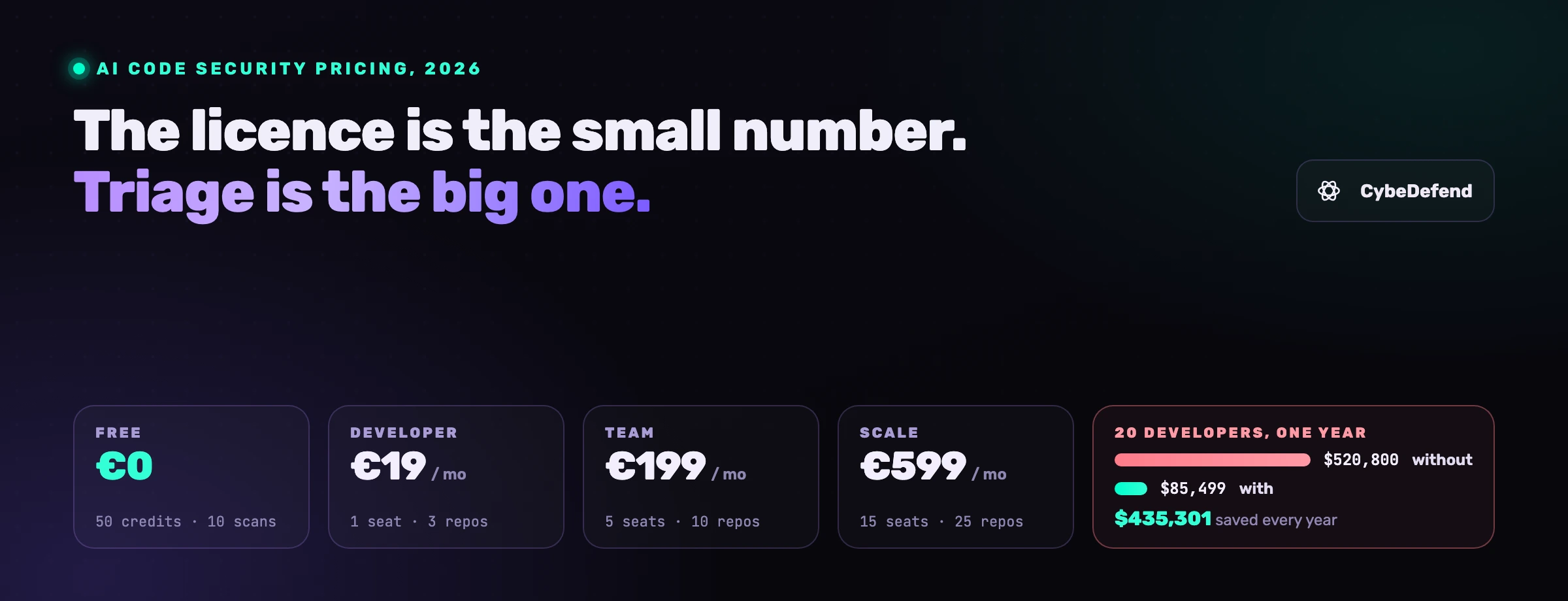
CybeDefend prices by plan, from €0 to €599 / $699 a month on the published tiers: each includes seats and repositories, with a fixed add-on rate above that. Every account starts free, with no card, no time limit and the whole platform. The figures below are the ones on the pricing page, quoted so the comparisons below rest on real numbers.
| Plan | Monthly | Annual (billed yearly) | Included | Extends to |
|---|---|---|---|---|
| Free | €0 | €0 | 50 AI credits and 10 static scans, the whole platform, no card, no time limit | Upgrade only when you need more |
| Developer | €19 / $21 | €204 / $228 | 1 seat, up to 3 repositories, 100 AI credits a month | Team |
| Team | €199 / $249 | €2,148 / $2,748 | 5 seats, 10 repositories, 1,500 AI credits a month | 10 seats and 20 repositories, at +€20 / $24 per seat and +€10 / $12 per repository a month |
| Scale | €599 / $699 | €6,588 / $7,680 | 15 seats, 25 repositories, 5,000 AI credits a month, OWASP and CWE reports, SBOM and security policies | 25 seats and 50 repositories, same add-on rates |
| Enterprise | Custom | Custom | Past 50 repositories or 25 seats: your scale, your data residency and your audit needs in one quote |
Two details change the arithmetic. Annual billing applies to the base plan (the yearly price is roughly eleven months of the monthly one, an 8 to 11% saving depending on the plan and the currency), while add-ons are billed monthly. And the scanners are not the tiers: SAST, SCA, secrets, IaC, licence and CI/CD scans are in every paid plan, with unlimited static scans; container security starts at Team, AI-BOM and business-logic analysis at Scale. The plans differ by seats, repositories, integrations and reporting.
What does a team actually pay per year?
Between €204 and €7,788 a year for the four configurations below, worked through with the rates above, in euros, with annual billing on the base plan and add-ons billed monthly. The dollar figures follow the same arithmetic on the dollar price list, which is a separate list rather than a conversion, so the two never move in lockstep.
- One developer, three side projects. Developer plan: €204 a year ($228), or €19 a month if you would rather not commit.
- Five developers, ten repositories. Team plan with nothing extra: €2,148 a year ($2,748).
- Eight developers, fourteen repositories. Team plan plus three seats (€60 a month) and four repositories (€40 a month): €299 a month, which is €2,148 for the base plan plus €1,200 of add-ons, €3,348 a year.
- Twenty developers, twenty-five repositories. Scale plan plus five seats (€100 a month): €699 a month, which is €6,588 plus €1,200, €7,788 a year. In dollars: $7,680 plus $1,440, $9,120 a year.
The last configuration is the one our study modelled, and it is worth pausing on: for twenty developers, the licence is €389 per developer per year. One hour of the loaded engineer cost the study assumes, $87.50, buys more than two months of that seat.
The two costs no pricing page shows
The licence is the visible cost. The two invisible ones are the hours your developers spend fixing the rules an agent ignored, and the security findings that surface after merge. Our ROI calculator prices both from rates our own controlled study measured, and every assumption stacked on top of those rates is yours to change on the page.
What the study measured, on 30 tasks, three arms and 90 autonomous runs: an agent with no tool leaves 2.28 rule deviations per rule-bearing ticket; with a hand-maintained rules file in the repository, 2.27; with a perfect file kept word for word, 0.95; with VibeDefend in the loop, 0.28. An independent scanner counted 0.10 security findings introduced per task without a tool, 0.067 with a rules file, 0.033 with the layer, and all of the layer's were fixed inside the task. The layer's own token overhead was $1.20 per ticket, 18% more.
What the calculator assumes, and labels as assumptions: 10 rule-bearing tickets per developer per month (the study sweeps 5, 10 and 20), 60 minutes to fix one rule deviation by hand (30, 60 or 90), two hours for a security finding found after merge (one, two or four), a loaded engineer cost of $87.50 an hour, $700 a day, and, since 16 September, the time you spend keeping a rules file current, two hours a month per repository by default.
Run it for twenty developers on twenty-five repositories and the arithmetic is short. 20 × 10 × 12 = 2,400 rule-bearing tickets a year. Times 2.28, that is 5,472 broken rules without the tool; times 0.28 (0.284 unrounded), 682 with it. At one hour and $87.50 each: $478,800 against $59,640. Security findings: 240 against 79, two hours each, $42,000 against $13,860, and the layer is charged for findings the study saw it fix in-task, as a conservative allowance. On the tool side, the Scale plan with five extra seats, $9,129 at the paper's list prices, plus $1.20 × 2,400 = $2,870 of tokens.
a year for twenty developers without an agent-time layer: rule deviations and security findings fixed by hand after merge
the same team, same year, with VibeDefend in the agent loop, licence and tokens included
saved every year, 37.3 times the licence and the tokens; 21.2 times at five tickets a month, 60.2 at twenty
Sweep the ticket flow and the return moves, but not the sign: at five rule-bearing tickets per developer per month the same team saves $213,086 a year, 21.2 times the tool's cost; at twenty, $879,730, 60.2 times. The break-even sits at 0.21 rule-bearing tickets per developer per month, roughly one every five months. The live calculator prices the plan at today's list, so its totals land within ten dollars of the paper's.
Where the money goes is not mysterious: 5,472 rule deviations at an hour each is 5,472 engineer hours before a single security finding is counted. A tool that reports them after merge and leaves the fixing to a human has not saved that hour, it has scheduled it, which is the same reason most SAST findings are noise once they land in a queue nobody has time for.
Why the place a tool acts changes its price
A finding raised after merge costs the full remediation: the code is written, the developer has moved on, and someone comes back to understand the flaw, fix it and re-review it, the hour or two the calculator assumes. A finding at agent-time, while the diff is written, costs $1.20 of tokens: the agent rewrites the unsafe version before it lands.
Two tools with the same licence price and the same detection rate therefore have very different total costs, and the difference sits in the remediation column, not the price column.
That is what VibeDefend is priced to replace. It sits inside the coding agent, Claude Code, Cursor, Codex, Copilot or Windsurf, serves your rules on the diff and guards the shell commands. In our study the agent with the layer applied the exact rule in 89% of cases (57 of 64 graded rules), against 12% with no tool and 13% with a hand-maintained rules file in the repository, and that is what takes a ticket from 2.28 deviations to 0.28. If the rules file is your current plan, the long version of that measurement is worth an hour.
How to compare two quotes
Six questions settle most comparisons in an hour, and none of them is the headline price: the billable unit, the add-ons, where the tool acts, what the free tier really is, where the code goes, and how an annual discount interacts with monthly add-ons. Ask for every answer in writing, then model twelve months of your own growth before signing.
- What is the billable unit, exactly? Seats you assign, or contributors the vendor counts from git history? Ask for the definition in writing.
- What is an add-on? List SCA, secrets detection, IaC, container scanning, licence compliance and compliance reports, and mark which are in the base price.
- Where does the tool act? In the pull request, in CI, or inside the coding agent while the code is written? Price the remediation hours accordingly.
- What is the free tier? A time-limited trial, or a plan you can stay on? A free plan with a real allowance tells you the vendor expects to earn the upgrade.
- Where does the code go? EU or US processing, and whether the choice is yours. For regulated teams this is a cost too, paid later.
- Monthly or annual, and what about add-ons? Annual base plans are usually discounted; add-ons are usually monthly. Model your growth for twelve months before signing.
If you want the same comparison across the tools people shortlist most often, our guide to the best AI code security tools does it feature by feature.
Is an AI code security tool worth it for a three-person startup?
Yes, and the study's smallest rows show why. One developer on three repositories costs $26,040 a year in remediation with no tool and $4,050 with the layer, licence included, a 59.6 times return. Five developers on ten repositories: $130,200 against $21,841, 32.3 times. A team of three sits between those rows, on a Team plan at €2,148 a year.
The break-even is the number to keep. At five developers the tool pays for itself from 0.25 rule-bearing tickets per developer per month, one every four months; at one developer, from 0.1. The study offers the other reading too: over its thirty tasks, the layer's overhead is repaid if it avoids one average data breach with a probability of 0.0008%, or one €15,000 price-information fine with a probability of 0.24%. The question for a small team is not whether the tool pays for itself; it is whether you would rather spend those hours on the product.
Start on the free plan, 50 AI credits and 10 static scans with the whole platform, no card and no time limit, or book a demo if you would like us to run the calculator on your own numbers.
Frequently asked questions
How much does an AI code security tool cost?
Between nothing and a five-figure annual contract. On CybeDefend's published list: free for 50 AI credits and 10 static scans, €19 / $21 a month for one developer, €199 / $249 a month for five developers and ten repositories, €599 / $699 a month for fifteen developers and twenty-five repositories, and a quote past 25 seats or 50 repositories. Elsewhere, ask what the billable unit is before you compare headline prices.
What is the most cost-effective way to check AI-generated code for vulnerabilities?
Check it while the agent writes it, not after it merges. Our controlled study measured the layer's cost at $1.20 of tokens per ticket, against the hour of engineer time the calculator assumes for a deviation fixed after merge, and the layer cut deviations per ticket from 2.28 to 0.28. For twenty developers that is $435,301 a year saved against $9,129 of licence and $2,870 of tokens. A free plan with a real allowance is the cheapest way to test that on your own repository.
How much does SAST cost?
Standalone SAST is usually priced per developer seat or per contributing developer, from a monthly per-developer fee to enterprise contracts negotiated on volume. In 2026 most teams buy SAST inside a platform that also covers SCA, secrets and IaC, so the meaningful figure is the platform price and which of those are add-ons. On CybeDefend, SAST is in every plan, unlimited on every paid plan, from €19 a month for one developer.
Is there a free AI code security tool?
Yes. CybeDefend's free plan gives 50 AI credits and 10 static scans, with access to the whole platform, no card and no time limit. Open-source scanners are also free to run, at the cost of hosting, tuning and triaging their output yourself.
What is the cheapest AI code security tool?
For a single developer, a free plan or a Developer plan at €19 / $21 a month (€204 / $228 a year billed annually) is the floor for a hosted tool. Below that you are running open-source scanners yourself, which is free in licence terms and expensive in hours.
Do I pay per seat or per repository?
On CybeDefend, both are included in the plan, and both extend with add-ons: +€20 / $24 per extra seat and +€10 / $12 per extra repository a month on Team and Scale, billed monthly even on an annual plan. Elsewhere, check whether "developer" means a seat you assign or a contributor counted from git history.
What does the CybeDefend free plan include?
50 AI credits and 10 static scans, with access to the whole platform, no card and no time limit. The credits go on AutoFix patches and business-logic analyses; the scans cover SAST, SCA, IaC and secret detection. Nothing upgrades on its own: a paid plan starts the day you need unlimited static scans.
How is the ROI of a code security tool calculated?
Rule-bearing tickets a year (developers × tickets per month × 12), times the deviations per ticket the study measured for what you run today and for the layer, times your remediation time and loaded cost; plus the security findings found after merge, priced the same way; plus, for a rules file, the hours spent keeping it current; minus the licence and $1.20 of tokens per ticket. Our ROI calculator prints each line and lets you change every assumption.
Does the price depend on which AI coding agent we use?
No. The same plan covers Claude Code, Cursor, OpenAI Codex, GitHub Copilot and Windsurf; the price depends on seats and repositories, not on the agent.


