


On this page
- What is AI vulnerability remediation?
- Why can't an AI agent fix what it cannot see?
- How does an agent get live access to scanner findings?
- Which scanners feed the agent?
- What new use cases does live findings access unlock?
- Can the agent be trusted to triage false positives?
- How is this different from SAST autofix or autoremediation?
- Securing the agent and remediating the backlog: VibeDefend
- Frequently asked questions
- What is AI vulnerability remediation?
- Can an AI coding agent fix the vulnerabilities my scanner found?
- Which scanners should feed the agent?
- How is this different from a SAST tool's autofix button?
- Does the agent introduce new vulnerabilities while fixing old ones?
- Is my source code sent anywhere for this to work?
- Where does AI vulnerability remediation fit with the rest of AppSec?
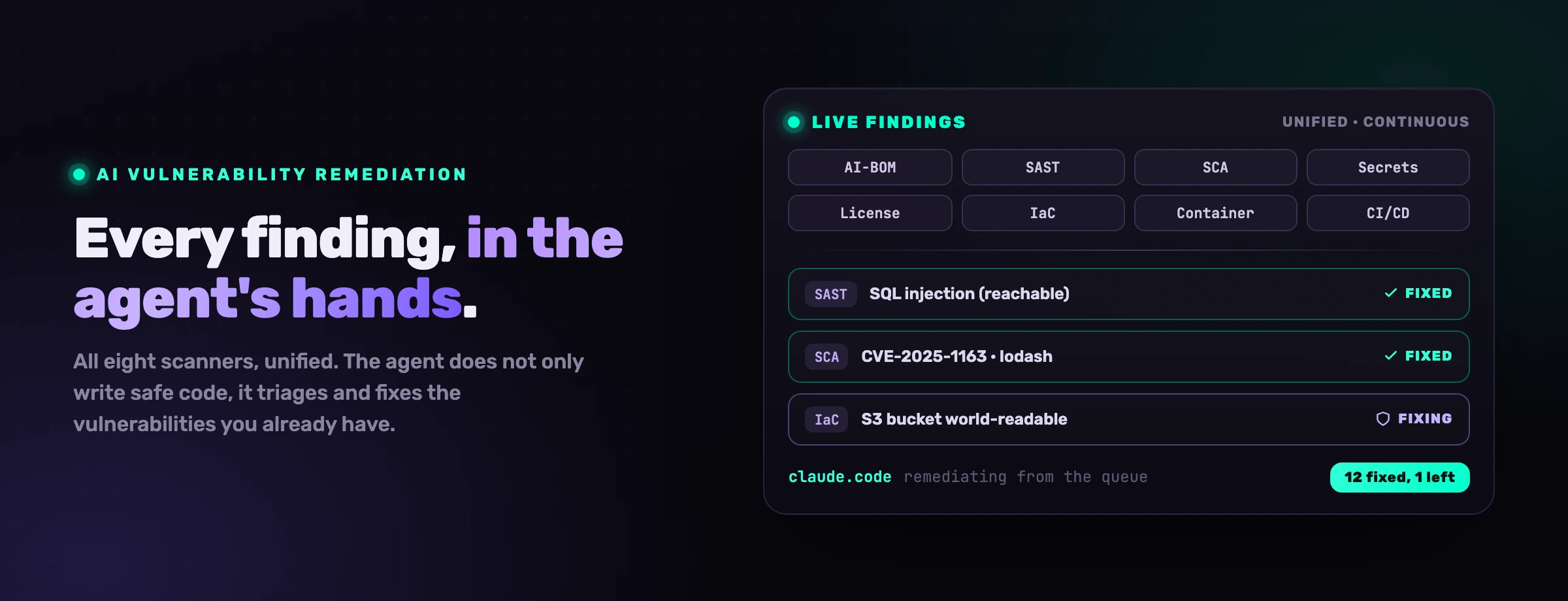
Most teams have two security problems that never meet. On one side, scanners that already found hundreds of real vulnerabilities, sitting in a dashboard nobody has time to work through. On the other, an AI coding agent writing thousands of lines a day with no idea any of those findings exist. AI vulnerability remediation closes that gap: it puts every finding your scanners produced into the agent's hands, live, so the same tool that writes the code also fixes the backlog. This guide explains what that means, which scanners feed the agent, the new use cases it unlocks, and how it differs from the autofix buttons you already ignore.
What is AI vulnerability remediation?
AI vulnerability remediation is using an AI coding agent to triage and fix the vulnerabilities your scanners detect, with the agent acting on real findings rather than guessing. The detection still comes from your security tools. What changes is who does the fixing, and when: instead of a finding waiting in a queue for a human to read, understand and patch, the agent that lives in your editor picks it up, with full code context, and remediates it as part of normal work.
The distinction that matters is between generation and remediation. Securing the code an agent writes (the subject of our pillar on AI coding agent security) keeps new vulnerabilities from being born. Remediation is the other half: the vulnerabilities you already have, the security debt that accumulated before the agent arrived and the issues that slip through anyway. A complete approach needs both, because writing safe code does nothing for the SQL injection a scanner flagged in a file the agent has not touched yet.
Why can't an AI agent fix what it cannot see?
Because an AI agent only acts on what is in its context, and a finding in a separate dashboard is not in its context. Ask a bare coding agent to "fix the security issues in this repo" and it will do something far weaker than it appears: it will skim the open files, pattern-match a few obvious smells, and miss everything your scanners spent real analysis finding. It has no list of confirmed vulnerabilities, no severity, no reachability, no idea which of the 1,200 lines it just read actually reaches an exploitable sink.
This is the visibility gap, and it is the reason "AI fixes vulnerabilities" mostly disappoints in practice. The agent is strong at applying a fix once it knows precisely what to fix and where. It is weak at deciding what is a real, reachable, severity-ranked vulnerability, which is exactly what a mature scanner already computed. The two are complementary, and keeping them in separate tools wastes both. The agent guesses at problems the scanner already solved, and the scanner's findings rot in a backlog because the one actor fast enough to clear them cannot see them.
of AI-generated code was vulnerable in independent testing, so the backlog grows even as the agent ships (NYU, Asleep at the Keyboard)
of AI coding-agent solutions were secure, vs 61% functionally correct (Carnegie Mellon SusVibes)
Broken Access Control, the top risk in the OWASP Top 10, and the kind a generic agent never spots unaided
How does an agent get live access to scanner findings?
The agent gets live access when a layer inside its loop connects it to the security platform that runs the scans, so findings flow into the agent's context on demand instead of living in a UI a human visits. The mechanics matter: the agent should be able to ask "what is open in this file, this service, this severity" and receive structured findings, with the location, the rule, the severity and the reachability, then act on them and report the fix back so the finding closes.
The hard requirement is that the findings are unified. A coding agent wired to one scanner is marginally useful; wired to your whole code security platform it changes the job. CybeDefend runs its scanners over the same codebase and resolves them into a single Security Code Knowledge Graph, so when the agent asks about a file it gets the full picture, not a SAST-only slice. That unified view is what lets the agent reason about a vulnerability the way a security engineer would: not "here is a pattern" but "here is a reachable SQL injection on a route that handles payments, and here is the dependency CVE underneath it".
Detection has been solved for a decade. The bottleneck was never finding vulnerabilities, it was the human hours between a finding and its fix. The agent is the actor that closes that gap, once it can finally see the findings.
Which scanners feed the agent?
All of them, which is the point. A partial view forces the agent back into guessing. CybeDefend unifies its scanners and feeds every result into the agent through the Live Findings layer:
- SAST with reachability. Static analysis that follows untrusted input from source to sink, so the agent fixes the injection that is actually reachable, not the 1,000 that are not. We go deep on why this matters in why most SAST findings are noise.
- SCA. Vulnerable dependencies and the transitive graph beneath them, so the agent knows which upgrade closes which CVE.
- Secrets detection. Leaked tokens and keys caught before the commit, surfaced to the agent so it can rotate and remove them.
- IaC. Terraform, CloudFormation, Ansible and Kubernetes misconfigurations, so the agent fixes the world-readable bucket in the same session it touches the code that uses it.
- CI/CD. GitHub Actions, GitLab CI, Jenkinsfile and Tekton pipeline weaknesses, so the supply chain around the build is in scope too.
Every scanner, one graph, one agent. The agent does not care which tool produced a finding; it sees a ranked, reachable, deduplicated list and works it.
What new use cases does live findings access unlock?
It turns the agent from a code generator into a remediation engine, which opens cases that were impossible when findings and the fixer lived apart.
The throughput change is the headline. A reviewer clears findings at human speed; an agent with the findings in context clears them at machine speed, with a human approving diffs rather than authoring them. The backlog stops being a place findings go to die.
Can the agent be trusted to triage false positives?
Yes, more than an unaided agent and more than a tired human, because it triages against reachability and real code context rather than a raw pattern. The reason most security backlogs are ignored is noise: a scanner that reports 1,200 issues where 12 are exploitable trains everyone to ignore all 1,200. When the agent works from reachability-aware findings, it inherits that filtering, so it spends its effort on the issues that can actually be reached and exploited.
Triage is still a judgment task, and the model is a draft author, not an oracle. The right posture is the same one you use for generated features: the agent proposes a verdict and a fix, a human approves the diff, and every action lands in an audit trail. What changes is the ratio. Instead of a person reading every finding from scratch, the person reviews the agent's reasoning on the findings that survived reachability filtering, which is a far smaller and higher-signal set. We cover why that filtering is the whole game in business logic flaws in AI-generated code and why most SAST findings are noise.
How is this different from SAST autofix or autoremediation?
The difference is context and scope. A scanner's built-in "autofix" suggests a templated patch for a single finding in isolation, with no knowledge of your business logic, your conventions, or the other findings around it. AI vulnerability remediation runs in the agent that already understands the whole repository, works the unified findings from across the platform, and applies fixes that fit your codebase rather than a generic template.
Read the two columns as different ambitions. Autofix patches a finding. Agent remediation closes the loop between a unified security platform and the actor fast enough to act on all of it, in the place the code is actually written.
Securing the agent and remediating the backlog: VibeDefend
VibeDefend is the agent-time layer that does both halves. It is a free npm CLI that installs in about five seconds and wires Claude Code, Cursor, Windsurf, OpenAI Codex and VS Code Copilot into four governance layers that run inside the agent loop.
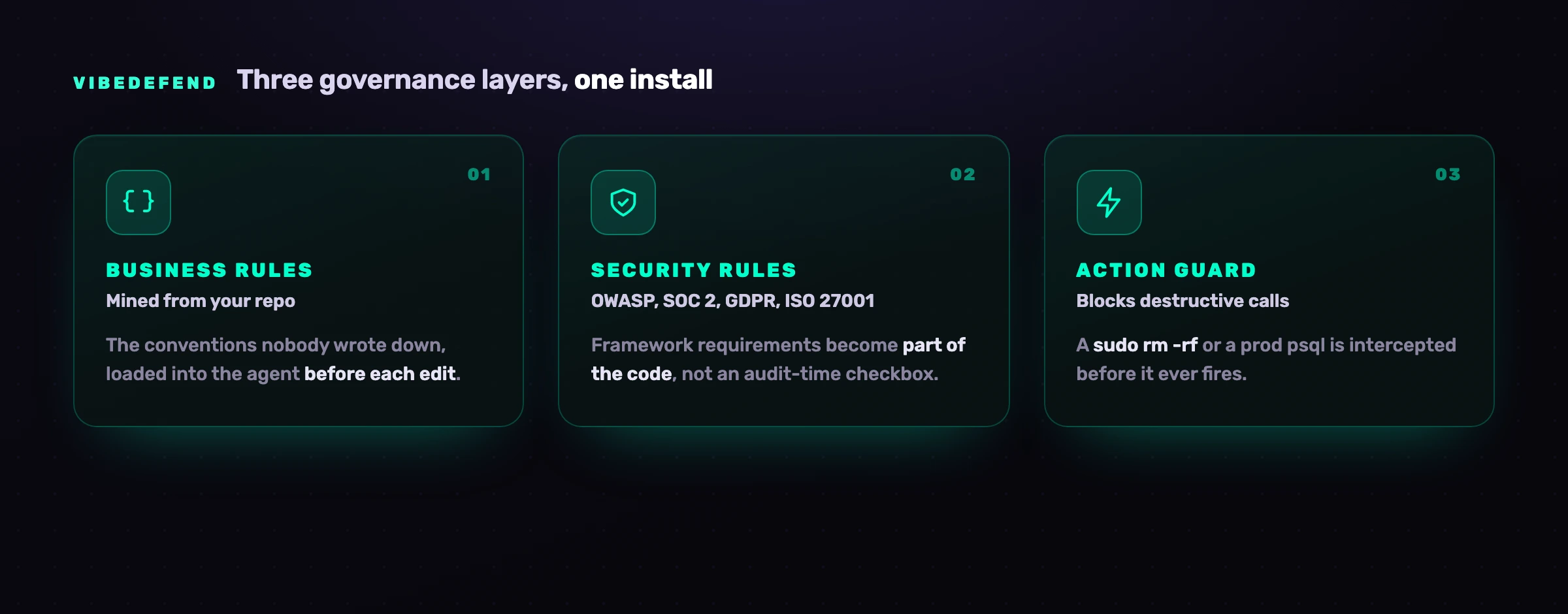
The first three layers govern what the agent writes: Business Rules mined from your repo, Security Rules from OWASP, SOC 2, GDPR and ISO 27001, and an Action Guard that blocks destructive calls before they fire. The fourth layer, Live Findings, governs what the agent fixes: it wires the agent into CybeDefend's code security platform, its scanners (SAST with reachability, SCA, secrets, IaC and CI/CD) running continuously, with every finding live in the agent's context. So the agent does not only write safe code, it triages and fixes the vulnerabilities you already have. The privacy model holds throughout: nothing about your code crosses the wire, only structured governance metadata, and EU and US regions are physically separate, chosen at install.
Frequently asked questions
What is AI vulnerability remediation?
AI vulnerability remediation is using an AI coding agent to triage and fix the vulnerabilities your security scanners already detected, with the agent acting on real, ranked findings rather than guessing. Detection still comes from your tools (SAST, SCA, secrets, IaC and CI/CD); the agent provides the fixing throughput, remediating findings in the loop with full code context and a human approving the diffs.
Can an AI coding agent fix the vulnerabilities my scanner found?
Yes, when it has live access to those findings. A bare agent asked to "fix the security issues" only skims open files and misses what your scanners computed. Connected to a unified findings layer, the agent receives each finding with its location, severity and reachability, applies a fix that fits your codebase, and reports it back so the finding closes. It is far more effective than an unaided agent and far faster than a human clearing the queue by hand.
Which scanners should feed the agent?
All of them, unified. A SAST-only view forces the agent to guess about everything else. The set that feeds the agent is SAST with reachability, SCA, secrets detection, IaC (Terraform, CloudFormation, Ansible, Kubernetes) and CI/CD pipeline analysis. CybeDefend resolves them into a single Security Code Knowledge Graph so the agent reasons over one deduplicated, reachability-ranked list.
How is this different from a SAST tool's autofix button?
Autofix patches one finding from one tool with a templated change and no repository context. Agent remediation runs in the coding agent that already understands your whole codebase and conventions, works the unified findings from every scanner, prioritizes by reachability, and avoids re-introducing issues because it sees what is open in a file before editing it. It also logs each verdict and fix to an audit trail.
Does the agent introduce new vulnerabilities while fixing old ones?
It can, like any author, which is why remediation and prevention belong in the same layer. With agent-time governance the same loop that fixes a finding also enforces your business and security rules on the new code, and a human reviews every diff. Pair that with a SAST gate in CI as a backstop and the net direction is down, not sideways.
Is my source code sent anywhere for this to work?
No. With VibeDefend the decisions happen locally next to the agent, and only structured governance metadata (the rule or finding that applied, the file path, the severity, a timestamp) reaches the backend. No source code and no prompt contents cross the wire, and EU and US regions are physically separate, chosen at install time.
Where does AI vulnerability remediation fit with the rest of AppSec?
It is the remediation half of AI coding agent security. Your scanners keep detecting, CI keeps gating, and humans keep reviewing. The agent removes the bottleneck in the middle: the hours between a finding being raised and a fix being written. Detection plus unified findings plus an agent fast enough to act on them is how the backlog finally goes down instead of up. For the hands-on version, see how to secure a whole application in 5 minutes.


