On this page
- The three questions that actually separate these platforms
- The field, platform by platform
- What almost nobody covers, updated
- What moving the control point actually looks like
- How to actually choose, in four questions
- The comparison we would run if we were buying
- Frequently asked questions
- What is the best AI security platform for detecting vulnerabilities?
- Is more detection coverage always better?
- How do these platforms differ on false positives?
- How is Snyk Evo different from agent-time enforcement?
- Which platforms can actually refuse an agent's action?
- Should a startup buy an enterprise AppSec platform?
- When should you buy something other than CybeDefend?
- How is this different from your buyer's guide?
- Do the rankings change when a new model ships?
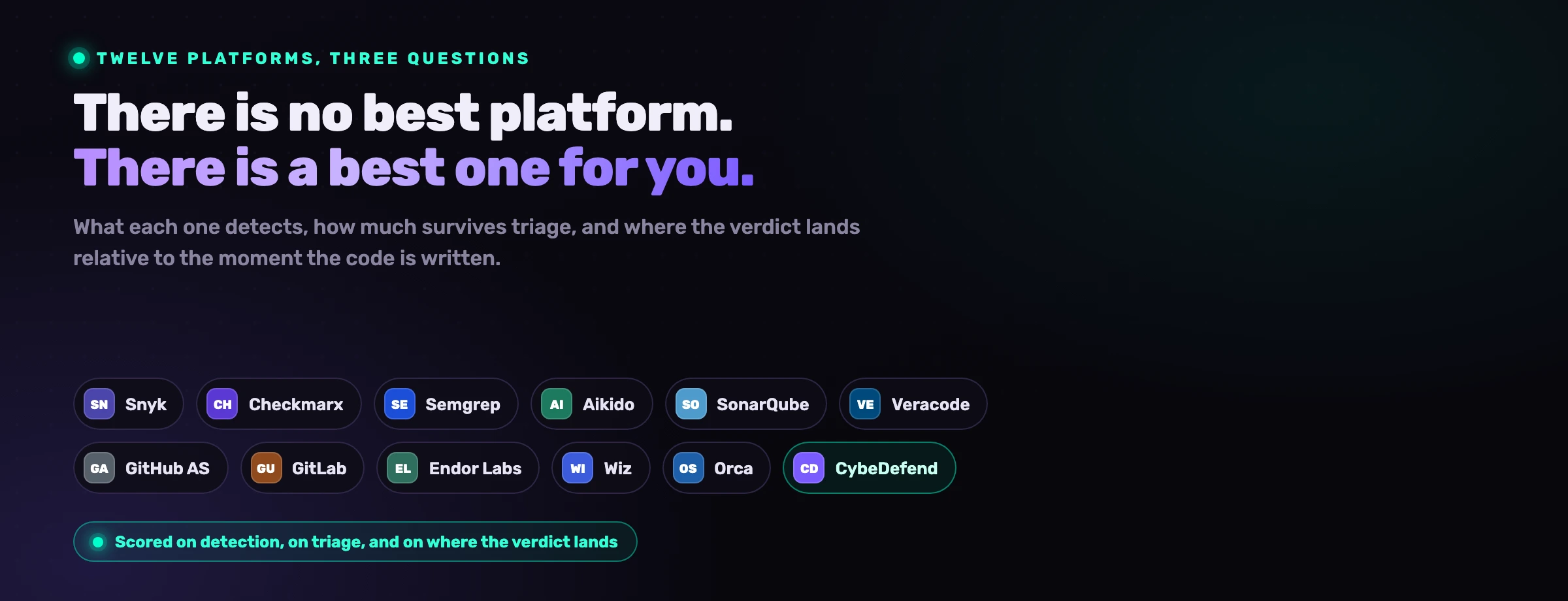
Something changed in this market in the last six months, and most comparison content has not caught up. Detection stopped being the axis. Every serious platform now finds SQL injection; what separates them is where their verdict arrives relative to the moment an agent writes the code, and whether anything can refuse an action rather than report on it afterwards. This piece scores twelve platforms on that, with the vendors' current positioning rather than last year's.
The three questions that actually separate these platforms
Most comparison tables list forty checkmarks and settle nothing, because forty rows hide the three that decide the outcome. Strip it back and every platform in this market answers three questions differently.
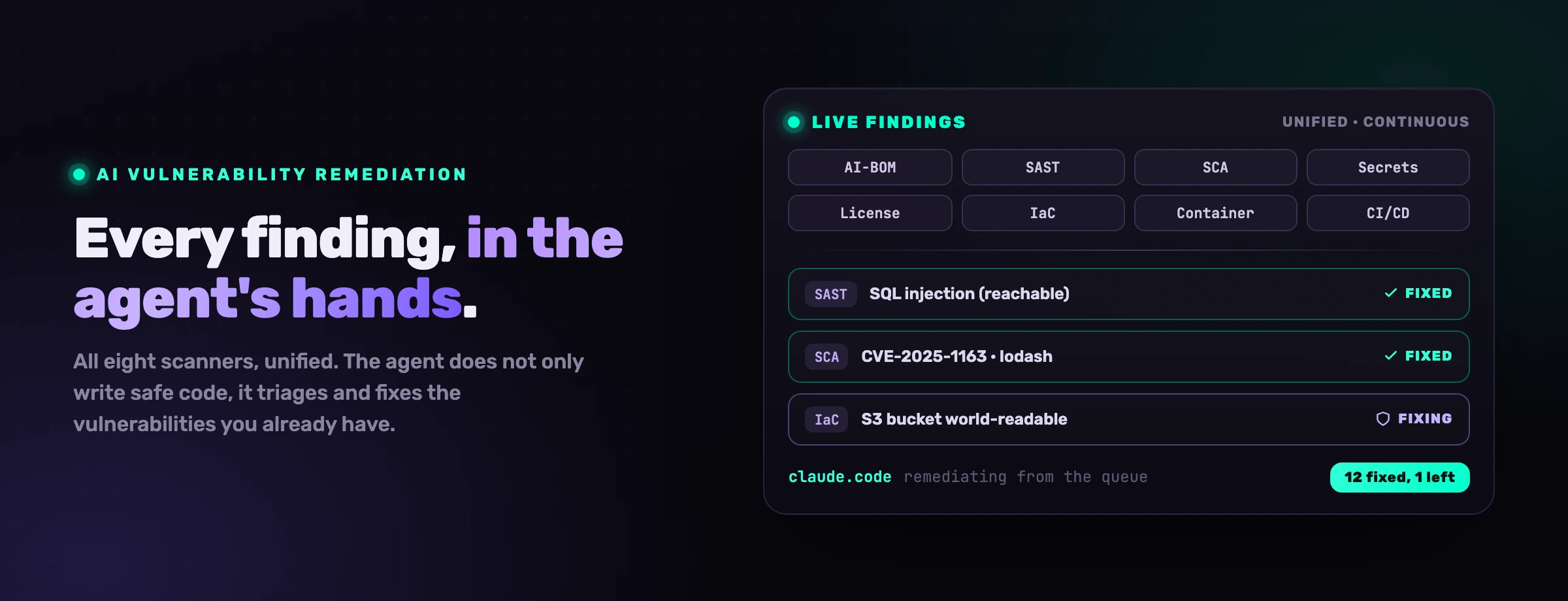
What does it detect? Every serious platform now covers SAST and SCA. The differences are at the edges: infrastructure as code, secrets, containers, pipelines, and the two surfaces that were empty a year ago and are filling fast, which are AI component inventory and prompt injection reaching a coding agent. Coverage breadth is the easiest thing to compare and the least decisive, because a surface nobody triages is not a surface you defend.
How much survives triage? A platform that reports 1,200 findings and one that reports 12 can be running identical rules. The difference is whether reachability, exploitability and application context are applied before emission or left to you. We wrote the mechanics up in why most SAST findings are noise. This is where budgets quietly go to die.
Where does the verdict land, and can anything refuse? Historically the answer was "in CI" or "in the pull request", and that was fine because a human sat there. In 2026 an agent writes at a cadence no reviewer matches, so a verdict arriving at the pull request arrives after the decision. And a verdict is not the same as a refusal: reporting that an agent ran a destructive command is a different product from declining to run it. This is the axis that moved, and 2026 is the year several vendors moved onto it.
The field, platform by platform
Scored on the three questions above, against what each vendor ships and says today rather than what the category looked like a year ago. Several of these entries changed materially in 2026 and are marked. The line with an arrow is what each one is genuinely best at; the line with an exclamation is what you should know before you sign. Every lockup links to the vendor's own site, so you can check us rather than take our word for it.

Repositioned in 2026 around agentic development. Evo COS went generally available at Black Hat in August, alongside AI-SPM, an AI-BOM, agent red teaming and Snyk Secrets.
→The broadest answer to agentic development from a single vendor. Evo Continuous Offensive Security reasons about application intent to find architectural and business-logic flaws, with a separate validation model clearing each finding and a runnable proof of concept attached.
!Offensive testing runs against a deployed application, so the verdict is a working exploit rather than a check on your specification. Prevention gates report and block at commit, PR and CI. Nothing here refuses an agent's shell command mid-session. Per-developer pricing still scales with the team, not the risk.
Detailed comparison
No longer the supply-chain specialist. Endor Labs now positions as an agentic AppSec platform: policy at the moment of action, AI SAST, package firewall, secrets and container reachability under one harness.
→The closest thing to agent action governance from anyone but us. AURI checks every agent action against policy before it runs, with allow, block or ask-a-human, and records it. Dependency reachability is still among the sharpest in the market.
!The action layer is new and the published evidence is vendor benchmarks rather than a controlled comparison. Their logic-flaw claim covers security logic, a missing authentication check or a dropped OAuth state parameter, not conformance to your own business rules.
Detailed comparison
The enterprise incumbent, repositioned around agentic development without giving up what made it a procurement default.
→Enterprise governance. Mature policy engine, reporting and procurement paths that pass a security review, now with an agentic layer on top of hybrid scanning.
!Heavy to deploy and tune. Overkill for a team of ten, and the setup cost is real and measured in weeks.
Detailed comparison
The consolidated middle ground, now spanning four products from code to runtime. Still the honest answer for a team of ten with no security engineer.
→Breadth per euro, and it grew. Code, cloud, AI pentesting and runtime protection from one vendor at a price a small team can sign, with autotriage that genuinely cuts the queue.
!Broad rather than deep. No individual capability matches the specialist in that capability, and the agent-time surface is thinner than the marketing implies.
Detailed comparison
The open-rule engine with an assistant layer for triage, still the most inspectable option in the list.
→Custom rules. If you want to encode your own patterns and read exactly what a rule does, nothing else is as transparent, and that transparency is worth more than it looks when you have to defend a finding.
!The power is in writing rules. A team that will not maintain a ruleset gets a fraction of what it expects.
Detailed comparison
The quality incumbent, now pitched squarely at AI slop and the reliability of generated code.
→Code quality first, security second, and it has leaned hard into verifying AI-generated code. If your team already lives in quality gates, this rides along at no integration cost.
!Security is an extension of a quality product, not its core. Reachability is limited and the agent-time surface is not the point.
Detailed comparison
The compliance-oriented option, now positioned as application risk management for the AI-coding era.
→Regulated environments and formal attestation. The longest track record with auditors in this list, and that is a real asset when a signature is the deliverable.
!Scan-and-report cadence at heart. The verdict is a long way from the keyboard, whatever the AI-era framing on the homepage.
Detailed comparison
The path of least resistance when your whole life is already in one place.
→GitHub-native teams. Zero integration work, CodeQL is a serious engine, and it is already in the bill.
!Only as good as your GitHub gravity. Coverage outside code and dependencies is thin, and there is no agent-session layer.
Detailed comparison
The equivalent trade for the other half of the market.
→GitLab-native teams, same logic. Security built into a delivery flow and a licence you already pay for.
!Bundled means adequate rather than best in class, on every single surface.
Detailed comparison
The cloud security platform, reaching further back toward code each release.
→Cloud runtime context. Still unmatched at connecting a finding to what is actually exposed in production, and now stitching code, cloud and runtime into one graph.
!Starts from the cloud, not the codebase. Code-level detection is not where it wins, and the moment of writing is not its moment.
Detailed comparison
Cloud-first posture management with a code-adjacent surface.
→Agentless cloud coverage with very fast time to value, now with an AI-generated-code surface bolted to a CNAPP.
!Same shape as above. The strength is posture, not the moment of writing.
Detailed comparison our platform
Business-logic conformance first: the discount that has to apply after commercial promotions, the refund computed on what the item actually bore. Plus agent-time enforcement across every coding agent on the machine.
→Every coding agent on the machine and the code they produce, from one setup. The control point moves inside the agent: rules and findings reach the model while it writes, and a hook can refuse an action before it runs. Above all it checks business logic against the rules you actually wrote, the class that has no CWE and that no scanner or pentest reaches.
!Built for teams who code with agents. If yours does not yet, most of what makes this different will not apply, and a broader platform is the better buy today.
What almost nobody covers, updated
A year ago three surfaces were empty across this whole market. Two of them are filling, and pretending otherwise would make everything else here less believable.
AI component inventory is no longer a gap. Models, datasets, prompts, agents, MCP servers and guardrails ship inside applications and the EU AI Act asks about them. Snyk now publishes an AI-BOM with MCP server and skill risk analysis, Endor Labs inventories the same layer, and we have shipped AI-BOM for a while. If a vendor still has no row for this, that is now a meaningful gap rather than an industry norm.
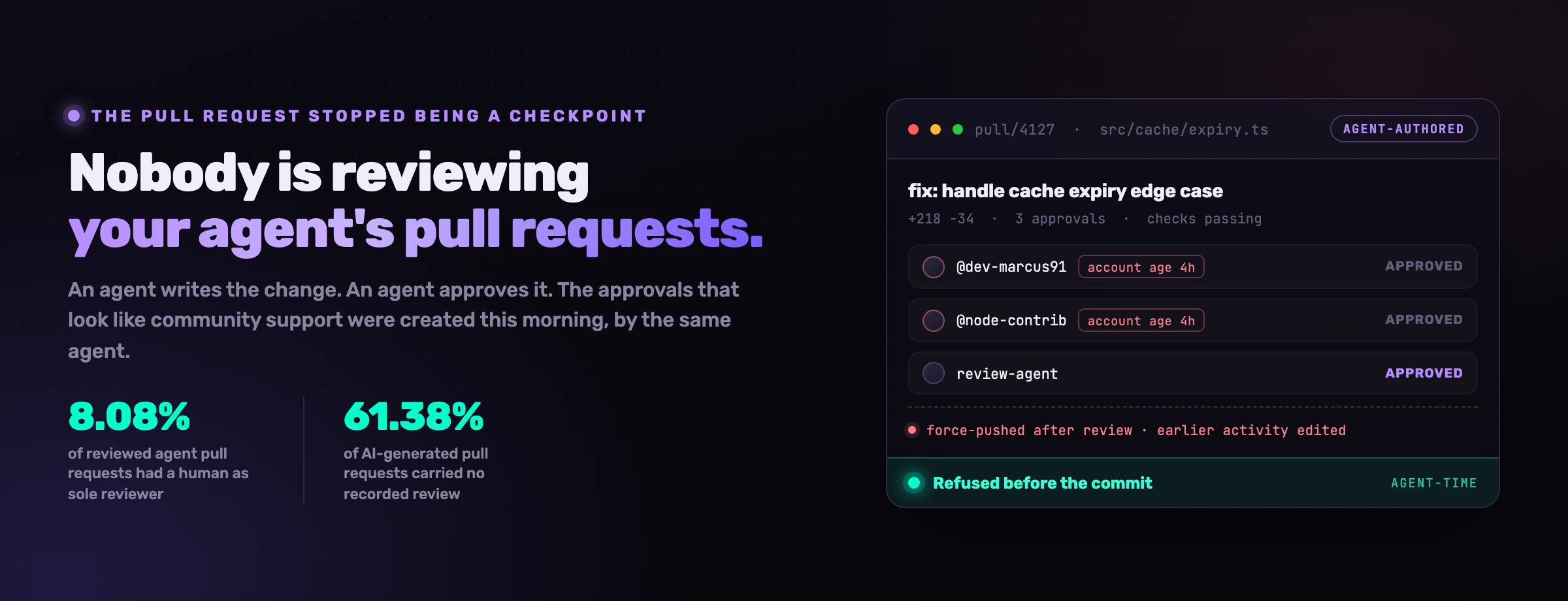
Agent action governance has exactly two serious entrants. Refusing an action is not the same as reporting it, and until this year nothing in application security could decline a command. Endor Labs now checks each agent action against policy before it runs. We do the same. Everyone else in this list secures the code an agent produces, which leaves a session that writes flawless code and reads a credentials file entirely uncovered. See instruction file injection.
Conformance to your own business rules is still nobody's product. This is the distinction that survives the 2026 repositioning, so it is worth being precise. Snyk's Evo finds business-logic flaws an attacker can exploit, which is real and valuable. Endor's logic flaws are security logic: a missing authentication check, a dropped OAuth state parameter. Neither answers whether your employee discount applies after commercial promotions rather than before, or whether a refund is computed on what the item actually bore. Those are not exploitable by an attacker and they have no CWE, which is exactly why no scanner and no pentest reaches them, and why they cost money quietly. We wrote it up in business logic flaws in AI-generated code.
What moving the control point actually looks like
Every product in this list waits for an artefact: a commit, a pull request, a merged branch, a deployed application. That was the right design while a human wrote the code, because a human stood at each of those gates. It stops working when the thing producing the code writes faster than anyone reads, and it stops working quietly. Nothing breaks. The queue simply grows and the review becomes a formality.
So we did not add another gate downstream. We moved the gate to the only moment where a fix still costs nothing: while the model is writing.
One command, every agent
The installer detects the coding agents already on the machine and points them at the same server. Claude Code, Cursor, Codex, Windsurf, Copilot: one setup instead of five config files kept in sync by hand, and no YAML to write.
Your rules, mined from your own code
This is the part nobody else does. The rules come from patterns already present in your repository, so the model enforces how your team actually writes: the discount that has to apply after commercial promotions, the refund computed on what the item really bore, the tenant check that must survive every new endpoint. No CWE, no signature, no benchmark row, and no scanner reaches them.
The verdict lands before the save
Rules and findings reach the model while it is still generating, so an unsafe pattern gets rewritten at the source instead of being filed as post-merge work. That is the difference between a fix that costs nothing and one that costs a sprint.
A hook can refuse the action
Writing code is half of what an agent does. It also runs commands, installs packages and reads files. A destructive command or a read of a credentials file can be declined before it fires, rather than audited a week later.
This does not replace your pipeline scanner, and we will not pretend otherwise: something still has to look at the code that was there before any agent touched it. What it replaces is the assumption that the pull request is where security happens. On a codebase where an agent writes most of the diff, that assumption is the vulnerability.
How to actually choose, in four questions
Who writes your code this quarter?
If a meaningful share is agent-written, weight "where does the verdict land" heavily. If it is human-written at human cadence, weight breadth and governance instead. This single question reorders the whole list.
Who triages, and how many hours do they have?
A platform that emits more findings than your team can read lowers security, because the queue becomes noise and noise gets ignored. Ask for a scan on your own repository and count what survives.
What has to be provable, and to whom?
An auditor, an enterprise questionnaire and your own engineers want different artefacts. If a signature is the deliverable, the compliance-oriented incumbents earn their price.
What does it cost when you double the team?
Per-seat pricing turns hiring into a security budget event. Check the shape of the curve, not the entry price.
The comparison we would run if we were buying
Do not buy from a table, including this one. Run the same fifteen-minute test on every shortlisted platform, on your own repository.
- Connect one real repository, not a demo project. Count how long it takes end to end.
- Read the first twenty findings. How many can you act on without opening the file to understand what the flag means?
- Take one business rule your codebase enforces and check whether anything on the list noticed it. This is the step that separates the field.
- Ask an agent to run something destructive and see whether the platform reports it, blocks it, or never knew.
- Price it at twice your current headcount.
The platform that survives all five is your answer, and it will not be the same answer as your neighbour's.
Frequently asked questions
What is the best AI security platform for detecting vulnerabilities?
There is no single answer, and any vendor giving you one is selling. For open-source dependency risk, the mature SCA specialists are strongest. For governance and audit, the enterprise incumbents. For breadth at a small-team budget, the consolidated platforms. For codebases where an agent writes a large share of the code, the deciding factor is whether anything arrives while the code is written and whether anything can refuse an action, which as of 2026 narrows the field to three vendors.
Is more detection coverage always better?
No, and this is the most common buying mistake. Coverage you do not triage is not defence, it is a queue. A platform reporting four figures of findings on every scan has delegated the analysis back to you. Compare what survives reachability and exploitability filtering, not what gets emitted.
How do these platforms differ on false positives?
Less than the marketing suggests on rules, more than it suggests on filtering. The engines converge; the difference is whether reachability, exploitability and application context are applied before a finding is shown. Several vendors now publish noise-reduction figures in the 95% range, which are vendor benchmarks rather than independent results. The only reliable test is running the shortlist on your own repository and counting the queue.
How is Snyk Evo different from agent-time enforcement?
Both target the class scanners miss, from opposite ends. Evo Continuous Offensive Security attacks a deployed application, reasons about its intent and returns a runnable proof of concept for what an attacker could exploit. Agent-time enforcement sits inside the coding session and checks the code being written against your own specification, before anything is deployed. The first proves exploitability and needs a running application; the second catches rules an attacker has no interest in but your finance team does. They are complementary far more than they are alternatives.
Which platforms can actually refuse an agent's action?
As of August 2026, two: Endor Labs, whose AURI layer checks each agent action against policy before it runs with allow, block or ask-a-human, and ourselves. Everyone else secures the code the agent produces rather than the actions it takes. The distinction matters because an agent session that writes perfect code can still run a destructive command or read a credentials file.
Should a startup buy an enterprise AppSec platform?
Usually not. The governance features that justify the price are the ones a ten-person team will never open, and the deployment cost is measured in engineer-weeks nobody has. Breadth per euro and time to first verdict matter far more at that stage. Our free tier exists for that reason: it is meant to give a verdict before anyone signs anything. See pricing.
When should you buy something other than CybeDefend?
Three cases, plainly. If you need a signed attestation for a regulator today, the compliance incumbents have the longer track record with auditors. If your priority is cloud runtime posture, the cloud-native platforms start from the right place and we do not. And if your code is mostly human-written and your review cadence still holds, agent-time enforcement solves a problem you do not have yet, so buy on breadth or governance instead.
How is this different from your buyer's guide?
The buyer's guide is the narrative version: the criteria that matter for AI-generated code and how to weigh them. This page is the field, platform by platform, scored on detection and on where the verdict lands. Read the guide to decide what you are optimising for, then use this one to shortlist.
Do the rankings change when a new model ships?
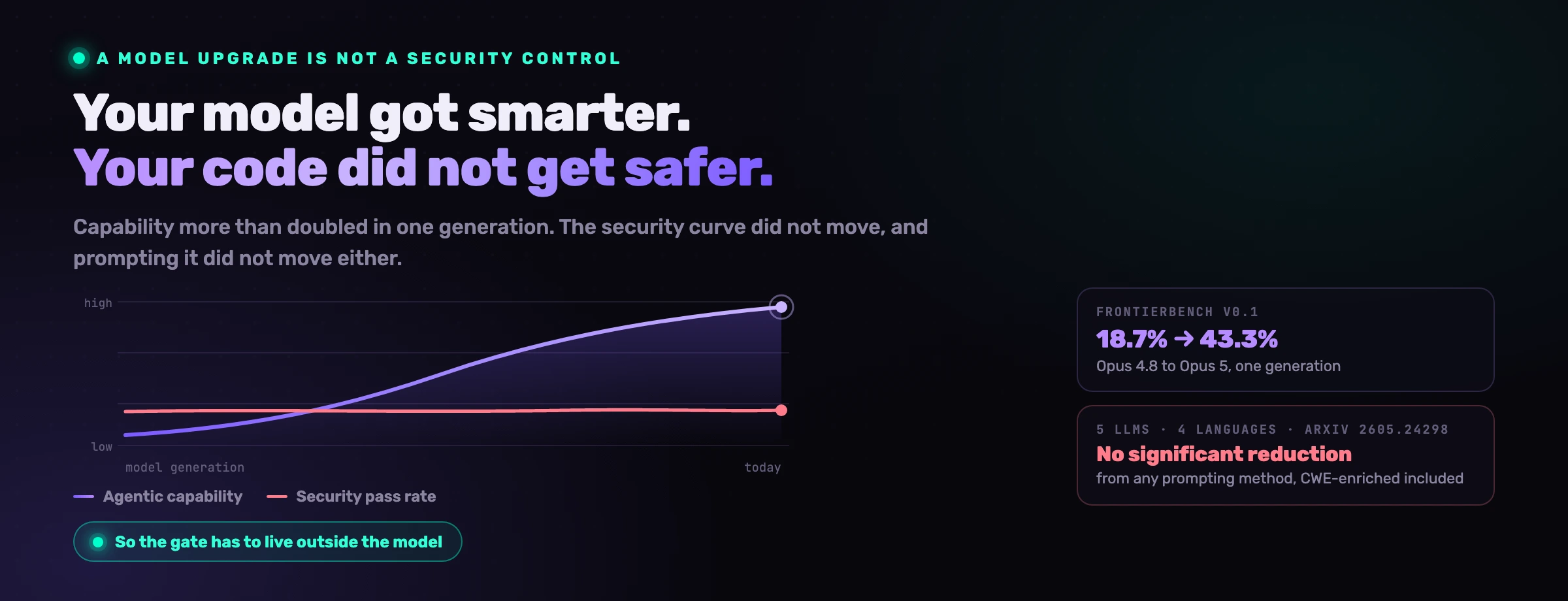
The detection rankings barely move. What moves is the volume of code arriving per day, which changes how much triage capacity you need rather than which engine is sharpest. We looked at that specifically in does a newer AI model write safer code: capability climbs, the security curve stays flat.