

On this page
- What is a security audit skill?
- Which security audit skills did we compare?
- How do the security audit skills compare?
- What does Anthropic's /security-review do?
- What does Cloudflare's security-audit skill do?
- What is in Trail of Bits' skills?
- What do Sentry's and PostHog's skills do?
- Which security audit skills prove a finding?
- Should a security audit skill run scanners too?
- Is a security audit skill safe to install?
- How do you choose a security audit skill?
- Where does /cybedefend fit?
- Frequently asked questions
- What is the best security audit skill for Claude Code?
- What does Claude Code's /security-review do?
- Is /security-review enough to secure a codebase?
- Does Cloudflare's security-audit skill work with Codex or Cursor?
- What is the difference between /security-review and the Claude Security plugin?
- Can a security skill prove a vulnerability?
- Is a security audit skill safe to install?
- Is CybeDefend open source?

The best security audit skill for Claude Code depends on what you need it to do with a flaw it suspects: report it, have a second agent check it, or prove it with a test that fails. Every skill in this guide turns your coding agent into a security reviewer, and each one stops at a different point on that path.
A security skill is also code your agent runs with your permissions, so the checks in our guide to whether Claude Code skills are safe apply to it as much as to any other skill. We read each one at its source on 23 November 2026, its README, its SKILL.md and its documentation: Anthropic's built-in /security-review and the tools around it, Cloudflare's security-audit skill, Trail of Bits' skills, Sentry's security-review and PostHog's security-audit. For each one we note who makes it, under which licence, which agents run it, whether it runs scanners, whether it proves a finding, and what you get at the end.
What is a security audit skill?
A security audit skill is a folder of instructions, and sometimes scripts, that a coding agent loads when you ask it for a security review. The center of it is a SKILL.md file: a name, a description that tells the agent when to use it, and the method it follows. The same format now works in Claude Code, OpenAI Codex, Cursor and other agents, and a command such as npx skills add installs a skill for the agent you pick.
A security skill and a scanner differ in who does the reading. A scanner such as Opengrep or Trivy matches known patterns and known advisories. A security skill hands the code to the model, which reads the routes, the handlers and the data model and judges what can go wrong. That reading can catch what a pattern cannot, such as a missing ownership check, and it can also produce findings that are not there. The design of each skill comes down to how it handles that second problem.
in Cloudflare's security-audit skill, from reconnaissance to a report derived from independently verified records.
confidence of actual exploitability: the bar Anthropic's /security-review prompt sets before it reports a finding.
of the vulnerabilities that repeated runs found in total, found by a single run of Cloudflare's skill in its own test runs, by its README.
plugins listed in Trail of Bits' skills marketplace on 23 November 2026, from code auditing to smart contracts.
Which security audit skills did we compare?
We took the ones that rank and the ones AI answers name. A search for "security audit skill" leads to Cloudflare's repository and to skill directories that list it next to PostHog's skill. A search for "claude code security review" leads to Anthropic's command and its GitHub Action. A vendor's list of the top Claude skills for cybersecurity, published by Snyk in March 2026, ranks Trail of Bits' code audit skills first. Sentry's security-review comes up in the same directories. We left out skills that cover one platform only, such as a single cloud provider's compliance checks, and skills built for offensive testing of live systems.
Each one was read at its source on 23 November 2026, and every quote below is in the sources file of this article.
How do the security audit skills compare?
The table puts each skill side by side by what it does. The first row is ours, and it is marked as such.
| Skill | Made by, licence | Runs in | Runs scanners | Proves a finding | What you get |
|---|---|---|---|---|---|
| /cybedefend (ours, CybeDefend Open Source, launching soon) | CybeDefend, open source | Your coding agent | Yes, Opengrep, Trivy, Gitleaks and zizmor among them | Yes, an exploit written as a test in your suite | A verdict from your policies, every finding in one queue |
| security-audit | Cloudflare, MIT | Agents with tool use and parallel sub-agents | No | A test in an OS sandbox, when one is available | findings.json and three Markdown reports |
| skills (marketplace) | Trail of Bits, CC BY-SA 4.0 | Claude Code, Codex | Yes, CodeQL and Semgrep (static-analysis plugin) | A PoC, as a unit test when feasible (fp-check) | Depends on the plugin, SARIF for static analysis |
| /security-review | Anthropic, prompt published under MIT | Claude Code, built in | No | No, told to read the code and not run it | A Markdown report in the session |
| Security review GitHub Action | Anthropic, MIT | GitHub Actions, with a Claude API key | No | No, a false positive filtering pass | Comments on the pull request, a JSON results file |
| Claude Security plugin | Anthropic, proprietary | Claude Code | No | Independent verifier agents, no test | Markdown, JSONL and SARIF, patch files |
| security-review | Sentry, Apache-2.0 (references CC BY-SA 4.0) | Claude Code, other agents through skills.sh | No | No, high confidence after research | Markdown findings and a "needs verification" list |
| security-audit | PostHog, MIT | PostHog's own repository | No | A reproducer test, on a local branch | Findings with an exploit request and a fix |
What does Anthropic's /security-review do?
/security-review is a command built into Claude Code that reviews the changes on your branch. In the words of the Claude Code documentation, it "reviews the diff between your branch and origin's default branch, identifying risks like injection, auth issues, and data exposure." It needs an origin remote, and it covers only what your branch changed, not the code already in the repository.
Anthropic published the prompt behind it in the claude-code-security-review repository, under the MIT licence, and reading it tells you how the command thinks. It may only run git and read files. It asks the model to "only flag issues where you're >80% confident of actual exploitability", hands each finding to a parallel sub-task that filters false positives, and drops anything scored below 8 out of 10. It also tells that sub-task, in so many words, "You do not need to run commands to reproduce the vulnerability, just read the code to determine if it is a real vulnerability." The result is a Markdown report with the file, the line, the severity, an exploit scenario and a fix.
The same repository is also a GitHub Action that runs the review on each pull request and comments on the lines it flags. It needs a Claude API key, and its README warns that "this action is not hardened against prompt injection attacks and should only be used to review trusted PRs." Anthropic's support page says the review should "complement, not replace, your existing security practices and manual code reviews."
Anthropic now ships two more layers next to the command. The security guidance plugin reviews the code Claude writes while it writes it, and the Claude Security plugin runs a deeper scan of a whole repository or a diff with several agents. Its findings "only appear in the report after independent verifier agents analyze them", the results come as Markdown, JSONL and SARIF, and a patch is checked against your tests when the code has them. The plugin's licence states that it is proprietary to Anthropic, it runs in Claude Code only, and its own page says it "doesn't replace your existing source-code security tools."
What does Cloudflare's security-audit skill do?
Cloudflare's security-audit skill, MIT, brings the deepest open method in this comparison. Its README calls it "the skill that seeded Cloudflare's vulnerability discovery harness", and it runs an audit in six phases: reconnaissance, coverage-led hunting, candidate validation, structured output, independent record verification and a report. Every candidate goes to "a fresh verifier that tries to disprove it", and its design principles say "the agent that checks a finding is never the agent that found it."
It is written for any coding agent: the SKILL.md calls itself "agent-neutral" and names roles, not products. It needs a model "that supports tool use and parallel sub-agents" and Node.js for two validators that check the findings file against a JSON schema. Each finding ends in one of three verdicts, confirmed, needs_validation or rejected, and only a confirmed finding gets a severity. The output lands outside your repository by default, as findings.json and three Markdown reports.
In daily use, the skill runs target code only "inside an OS-enforced sandbox" with no network, and when that sandbox is missing, the lead stays needs_validation. And it is honest about coverage: "In our test runs, a single run found roughly half of the vulnerabilities that repeated runs found in total." Runs are additive, so the second one starts from the first one's ledger. It runs no scanner of its own.
What is in Trail of Bits' skills?
Trail of Bits' skills are a marketplace of plugins, not one audit command, under the CC BY-SA 4.0 licence. You add the marketplace to Claude Code or Codex and pick the plugins you want. For a codebase audit, a handful matter:
- static-analysis runs CodeQL and Semgrep and parses their SARIF, "based on the Trail of Bits Testing Handbook".
- differential-review reviews a change with its git history.
- insecure-defaults looks for settings that fail open, "with a refuting verifier per candidate file".
- supply-chain-risk-auditor audits npm, PyPI and Go dependencies.
- fp-check verifies a suspected bug and builds proof-of-concept exploits, with "unit test PoCs (when feasible)".
This is the toolbox of a security firm, and it reads like one. It runs real scanners, which no other skill here does apart from ours, and fp-check is the strongest answer to false positives in the list. You pay for that in assembly, because fp-check activates when you ask whether a bug is real, not when you ask it to find bugs, so you chain the plugins yourself.
What do Sentry's and PostHog's skills do?
Both come from engineering teams that wrote them for their own code, and both read well as methods.
Sentry's security-review, in a repository under Apache-2.0 with reference material taken from the OWASP Cheat Sheet Series, asks the agent to research the whole codebase and to report only on the code you point it at. It reports high-confidence findings, puts the uncertain ones under "Needs verification", and skips the rest: "Report only what you've confirmed is exploitable after research." Its pages on frameworks that already escape or parameterize input are its strength, because they cut the classic false positives. It runs no tool and writes no test.
PostHog's security-audit lives inside PostHog's own repository, under its MIT terms, and starts from a threat model of the change. It refuses a finding without "a specific exploit request", and on a local branch it asks the agent to "write a reproducer test for each confirmed finding" that fails against the vulnerable code and passes once the fix is applied. That is the same rule we follow. It is written for PostHog, down to where each fix is filed, so you would adapt it before using it elsewhere.
Which security audit skills prove a finding?
Few of them do, and the difference shows in their own text. We pulled the lines each skill gives the agent about a flaw it suspects, straight from the source files on GitHub:
#!/bin/bash
# What does each security skill tell the agent to do with a flaw it suspects?
raw=https://raw.githubusercontent.com
check() {
  echo "== $1"
  curl -fsSL "$raw/$2" | grep -n -o -E "$3"
}
check "Anthropic /security-review" \
  anthropics/claude-code-security-review/main/.claude/commands/security-review.md \
  "You do not need to run commands to reproduce the vulnerability|Do not use the bash tool or write to any files"
check "Cloudflare security-audit" \
  cloudflare/security-audit-skill/main/skills/security-audit/SKILL.md \
  "Sandboxed local tests resolve behavior when all execution controls are available|If every control cannot be enforced, do not execute target code"
check "Trail of Bits fp-check (poc-builder)" \
  trailofbits/skills/main/plugins/fp-check/agents/poc-builder.md \
  "unit test PoCs \(when feasible\)"
check "Sentry security-review" \
  getsentry/skills/main/skills/security-review/SKILL.md \
  "Report only what you've confirmed is exploitable after research"
check "PostHog security-audit" \
  PostHog/posthog/master/.agents/skills/security-audit/SKILL.md \
  "write a reproducer test for each confirmed finding"
The output, on 23 November 2026:
== Anthropic /security-review
136:You do not need to run commands to reproduce the vulnerability
136:Do not use the bash tool or write to any files
== Cloudflare security-audit
40:If every control cannot be enforced, do not execute target code
144:Sandboxed local tests resolve behavior when all execution controls are available
== Trail of Bits fp-check (poc-builder)
17:unit test PoCs (when feasible)
== Sentry security-review
170:Report only what you've confirmed is exploitable after research
== PostHog security-audit
369:write a reproducer test for each confirmed finding
Read together, they sit on four rungs. A finding reported on the model's confidence stays an opinion, however well informed, and a finding a second agent failed to disprove is a better opinion. Once the code runs on the machine and shows the flaw, you have a fact for that run, and a failing test left in the suite keeps that fact: it proves the flaw today, and once the fix lands it fails the build if the flaw comes back.
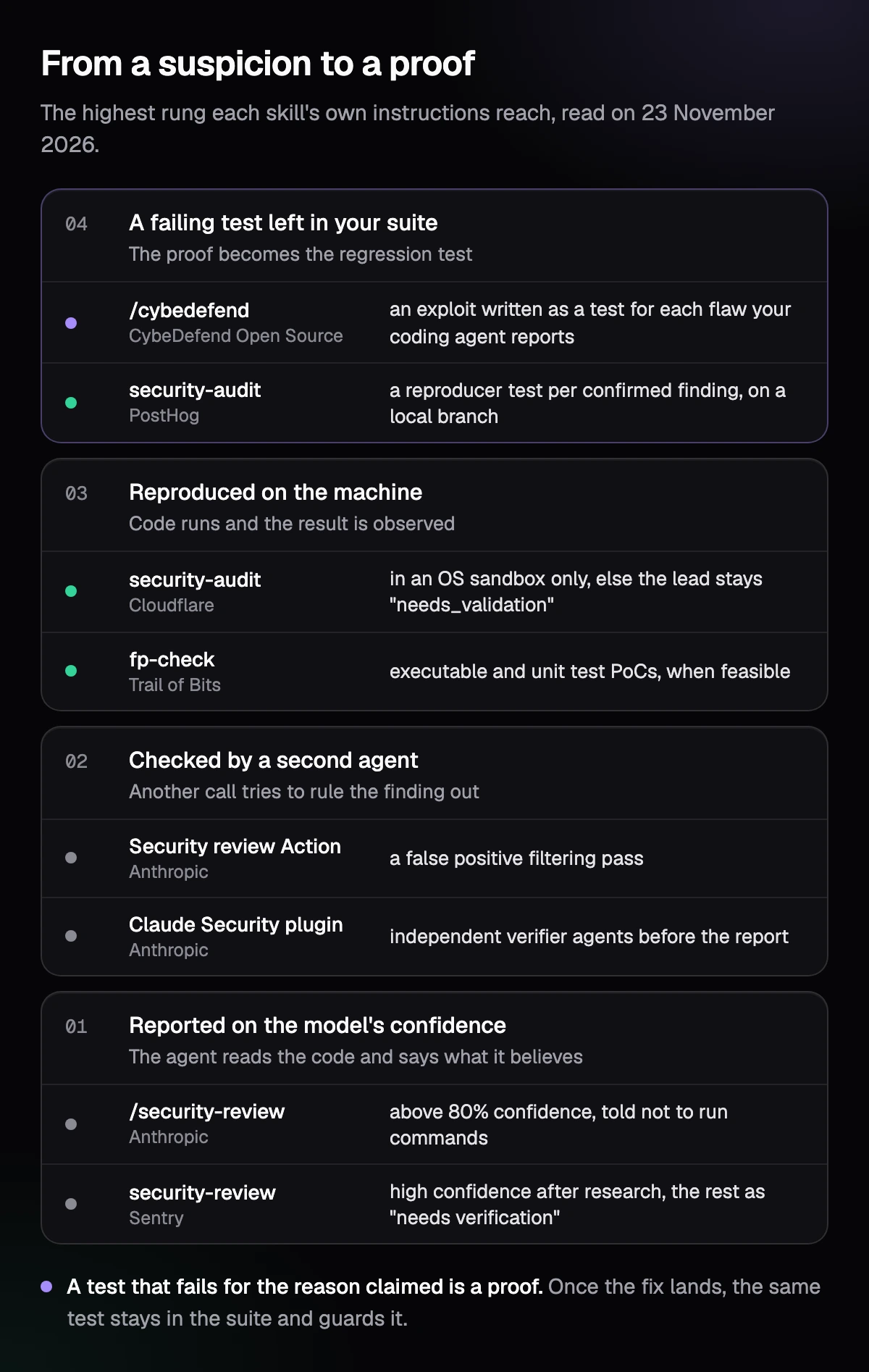
The top rung is the hardest to reach, because the agent needs a test runner and has to write code that calls the real handler. Our guide to finding business logic flaws with your coding agent walks through that method on a real flaw, with the failing test as printed.
Should a security audit skill run scanners too?
Yes, because the two find different things. A skill that only reads code spends the model's attention on what a scanner finds in seconds: an outdated package with a known CVE, a key committed six months ago, a GitHub Actions workflow that injects a pull request title into a shell. Anthropic says as much in its own stack, where the last layer is "your existing static analysis and dependency scanners."
What the open source scanners find
- Known patterns in your code (Opengrep)
- Dependencies with known advisories, and containers (Trivy)
- Secrets committed to the repository (Gitleaks)
- Unsafe CI/CD workflows (zizmor)
What a review by your coding agent goes after
Business logic
An order shipped before it is paid, a coupon applied twice, a refund larger than the payment. Each line is correct, and the flow is wrong.
Access rights
A read that skips the ownership check its sibling delete has, or an admin route that checks the session and not the role.
Data across tenants
A lookup by id with no organization filter, so one customer reads another's records.
Flaws that only show when the code runs
Two requests that race on one balance, a state machine with a step you can skip.
The order matters too. When the scanners run first, the agent starts from what they found and spends its time where they cannot see. Our review of open source SAST tools covers the scanners, and the triage problem they bring, which a skill can take on by judging each finding against the code.
Is a security audit skill safe to install?
A security skill is code like any other skill, and it reads your whole repository by design, often runs commands and sometimes runs your code. The checks below come from the skills' own pages.
The checks in are Claude Code skills safe take a few seconds per skill and apply here unchanged. For the agent itself, our guide to Claude Code security risks and best practices covers permissions, deny rules and the sandbox.
How do you choose a security audit skill?
Answer four questions in order, and the list shrinks fast.
The diff, or the whole repository?
/security-review and Anthropic's Action review what a branch or a pull request changed. Cloudflare's skill, the Claude Security plugin and /cybedefend can audit the whole repository, which also reaches code that has been there for years. Our article on reviewing an AI agent's pull requests covers the diff side.
Does it prove what it reports?
A finding with a failing test can be checked by running the test, and a finding without one has to be investigated by hand. Look for the top two rungs: a run on the machine, or a test left in the suite.
Does it run the scanners, or leave them to you?
Trail of Bits and /cybedefend run scanners. With the others you keep your scanners in CI and merge two lists of findings yourself.
Where do the findings go?
A Markdown report in a terminal is read once. SARIF goes into GitHub code scanning or a dashboard, and a queue with a policy decides what blocks the merge and keeps the history an auditor asks for.
Then check the agent. Anthropic's tools run in Claude Code. Cloudflare's skill and /cybedefend are written for any coding agent, and Trail of Bits supports Claude Code and Codex.
Where does /cybedefend fit?
/cybedefend is the skill of CybeDefend Open Source, the open source Snyk alternative, launching soon. One command in your coding agent runs a full audit of the repository you are in, in two layers.
It runs the AppSec scanners first, open source, with Opengrep, Trivy, Gitleaks and zizmor among them, for code, dependencies, secrets, infrastructure as code, CI/CD and containers. You keep the ones you want and add your own, since anything that writes SARIF lands in the same place. Then comes the AI scanner, run by your coding agent with CybeDefend's method. It starts from what the scanners found and a map of every entry point, reads what your code is meant to do, and goes after the flaws scanners can't see: business logic, access rights, data that crosses tenants, flaws that only show when the code runs. Each flaw it reports is proven with an exploit written as a test in your repository's own suite, and a lead it cannot prove stays a note that cannot block a merge. No extra model and no API key: the AI is the coding agent you already run, and its review never sends a request to a running system.
Every finding then lands in our agentic ASPM platform: one queue without duplicates, your team's policy deciding what blocks the merge, and the reports an auditor reads. The fix comes after, one finding at a time, each one proven by the same test going from red to green. To run it on your own code when it opens, join the CybeDefend Open Source waitlist.
Frequently asked questions
What is the best security audit skill for Claude Code?
It depends on the job. For a quick review of your branch, /security-review is built into Claude Code. For a deep audit of a repository led by agents, Cloudflare's security-audit skill has the fullest open method, and Trail of Bits adds CodeQL, Semgrep and proof-of-concept checks. If you want the open source scanners and an AI review in one command, with each flaw proven by an exploit written as a test, that is /cybedefend from CybeDefend Open Source, launching soon.
What does Claude Code's /security-review do?
It reviews the diff between your branch and the default branch of your origin remote for vulnerabilities such as injection, authorization flaws and data exposure. Its published prompt reports a finding only above 80% confidence, filters false positives in parallel sub-tasks, and tells the model to read the code without running it. It does not cover code your branch did not change.
Is /security-review enough to secure a codebase?
No, and Anthropic says so: its support page calls it a complement to "your existing security practices and manual code reviews", and its documentation places it next to the Claude Security plugin, Code Review and your existing scanners. It reviews a diff once, runs no scanner and proves nothing with a test.
Does Cloudflare's security-audit skill work with Codex or Cursor?
It is written to be agent-neutral and installs with the Skills CLI, which lets you pick the agent. It needs a model that supports tool use and parallel sub-agents, plus Node.js for its two validators.
What is the difference between /security-review and the Claude Security plugin?
/security-review is a single pass over your branch's diff. The Claude Security plugin, also from Anthropic, scans a whole repository or a diff with several agents, has every finding checked by independent verifier agents before the report, and can turn findings into patch files that you apply yourself.
Can a security skill prove a vulnerability?
Some can. PostHog's security-audit writes a reproducer test for each confirmed finding on a local branch, Trail of Bits' fp-check builds proof-of-concept exploits, and Cloudflare's skill runs local tests inside a sandbox. With /cybedefend, the AI scanner, run by your coding agent, proves each flaw it reports with an exploit written as a test in the repository's own suite.
Is a security audit skill safe to install?
Read it first, like any skill: what it allows itself in allowed-tools, what it runs, and whether it runs your code inside a sandbox. Pin the version you read. Our guide to whether Claude Code skills are safe gives three checks that take seconds.
Is CybeDefend open source?
Its open source edition, CybeDefend Open Source, is launching soon. The command /cybedefend chains the open source AppSec scanners and the AI scanner, run by your coding agent, which proves each flaw with an exploit written as a test, and keeps every finding in our agentic ASPM platform. Join the CybeDefend Open Source waitlist.