

On this page
- What is ASPM?
- What does an ASPM do, job by job?
- Why don't scanners give you a posture on their own?
- Which open source tools cover which ASPM job?
- DefectDojo: the register a search finds first
- OWASP Dependency-Track: components, SBOMs and EPSS
- SecObserve: a register built for CI
- Faraday, ArcherySec and GUAC
- Prioritization data: EPSS, KEV and OpenCVE
- What can a team run itself?
- Where does an open source ASPM stop?
- What changes when coding agents write the code?
- Where does CybeDefend fit?
- Frequently asked questions
- What is ASPM in simple terms?
- Is there an open source ASPM?
- Is DefectDojo an ASPM?
- What is the difference between ASPM and vulnerability management?
- What are the best ASPM tools?
- Does an ASPM find vulnerabilities?
- Is CybeDefend open source?

Open source ASPM is application security posture management built from tools you host yourself: one place that collects the findings of every scanner, keeps each finding once, ranks them by risk, applies your policy and reports on the result. CybeDefend Open Source is an agentic ASPM you run on your own servers, with the scanners and an AI scanner run by your coding agent behind one command; DefectDojo, OWASP Dependency-Track and SecObserve each cover part of the job, on top of the scanners we compared in our guide to open source SAST tools and what a team can run itself.
This guide explains what an ASPM does, maps each of its jobs to the open source tool that covers it, as read in each project's repository on 23 November 2026, and shows where an assembled stack stops. We also ran two open source scanners on a dependency file of one line to show why the layer exists: they wrote 45 entries for 20 distinct vulnerabilities.
What is ASPM?
ASPM, application security posture management, is the layer above your application security scanners that tells you where your risk stands across all of them. A SAST tool reports on your code, an SCA tool on your dependencies, a secret scanner on your credentials, and each one sees its own slice. The ASPM sees every application, every scanner and every finding, and answers the questions a security lead gets asked: what is open, what comes first, who owns it, and is it getting better.
The term comes from Gartner, whose definition was already being quoted in September 2023: ASPM "analyzes security signals across software development, deployment, and operation". Gartner splits the category into four tasks, as CSO Online's ASPM buyer's guide reports: vulnerability event correlation, prioritization and triage, code scanning orchestration, and risk management. The goal, in Gartner's words quoted there, is ratings good enough to "triage and prioritize security vulnerabilities identified by application security testing tools and other monitoring assets".
An ASPM is not a scanner: it finds nothing by itself and works on what your scanners report. It is also wider than a register of findings. Our guide to open source vulnerability management covers that register as an auditor reads it, with owners, deadlines and exceptions; this guide covers the whole layer, from the scanners' raw output to the decision of what to fix first.
What does an ASPM do, job by job?
Every ASPM, commercial or open source, does some version of the same six jobs, whatever name each vendor gives them.
- Collect. Pull the results of every scanner, from every repository, on every run. SARIF, the OASIS format that "defines a standard format for the output of static analysis tools", makes this easier, and many scanners write it; others write their own JSON.
- Normalize and deduplicate. Turn every scanner's severity scale and naming scheme into one, so that a flaw reported by two tools becomes one record.
- Correlate. Tie each finding to the application, the component, the commit and the team that owns it, so one fix closes every finding it should.
- Prioritize. Rank by more than a severity label: whether the flaw is exploited today, how likely it is to be, and whether the code that carries it is exposed.
- Apply policy. Decide which severity blocks a merge, which deadline applies, and who may accept a risk and until when.
- Report. Show the trend per team and per application, and keep the evidence a SOC 2 or ISO 27001 auditor samples.
Why don't scanners give you a posture on their own?
Because each scanner reports in its own language, and two scanners on the same code disagree on what they saw. We checked it on the smallest case we could build.
On 23 November 2026 we wrote a requirements.txt with one line, an old version of the Python package requests, and ran Trivy 0.76.1 and OSV-Scanner 2.7.0 on it with JSON output:
$ cat requirements.txt
requests==2.19.1
$ trivy fs --scanners vuln --format json --output trivy.json .
$ osv-scanner scan source --format json --output osv.json .
Trivy reported 5 vulnerabilities, all in requests. OSV-Scanner reported 40 records on four packages: requests, plus certifi, idna and urllib3, the dependencies it resolved behind that one line, and it grouped those 40 records into 20 vulnerabilities. Trivy's five are five of those twenty. Here is one of them, CVE-2024-47081, as each file holds it (fields extracted with jq):
// trivy.json
{"VulnerabilityID":"CVE-2024-47081","PkgName":"requests","InstalledVersion":"2.19.1","FixedVersion":"2.32.4","Severity":"MEDIUM"}
// osv.json, two records and one group for the same flaw
{"id":"PYSEC-2026-1872","aliases":["CVE-2024-47081","GHSA-9hjg-9r4m-mvj7"],"severity":null}
{"id":"GHSA-9hjg-9r4m-mvj7","aliases":["CVE-2024-47081","PYSEC-2026-1872"],"severity":"MODERATE"}
{"ids":["PYSEC-2026-1872","GHSA-9hjg-9r4m-mvj7"],"max_severity":"5.3"}
That is one flaw under three identifiers (a CVE, a PyPI advisory and a GitHub advisory), with its severity written three ways: MEDIUM, MODERATE and 5.3. Trivy keys on the CVE; OSV-Scanner keys on the advisories and keeps the CVE in a list of aliases.
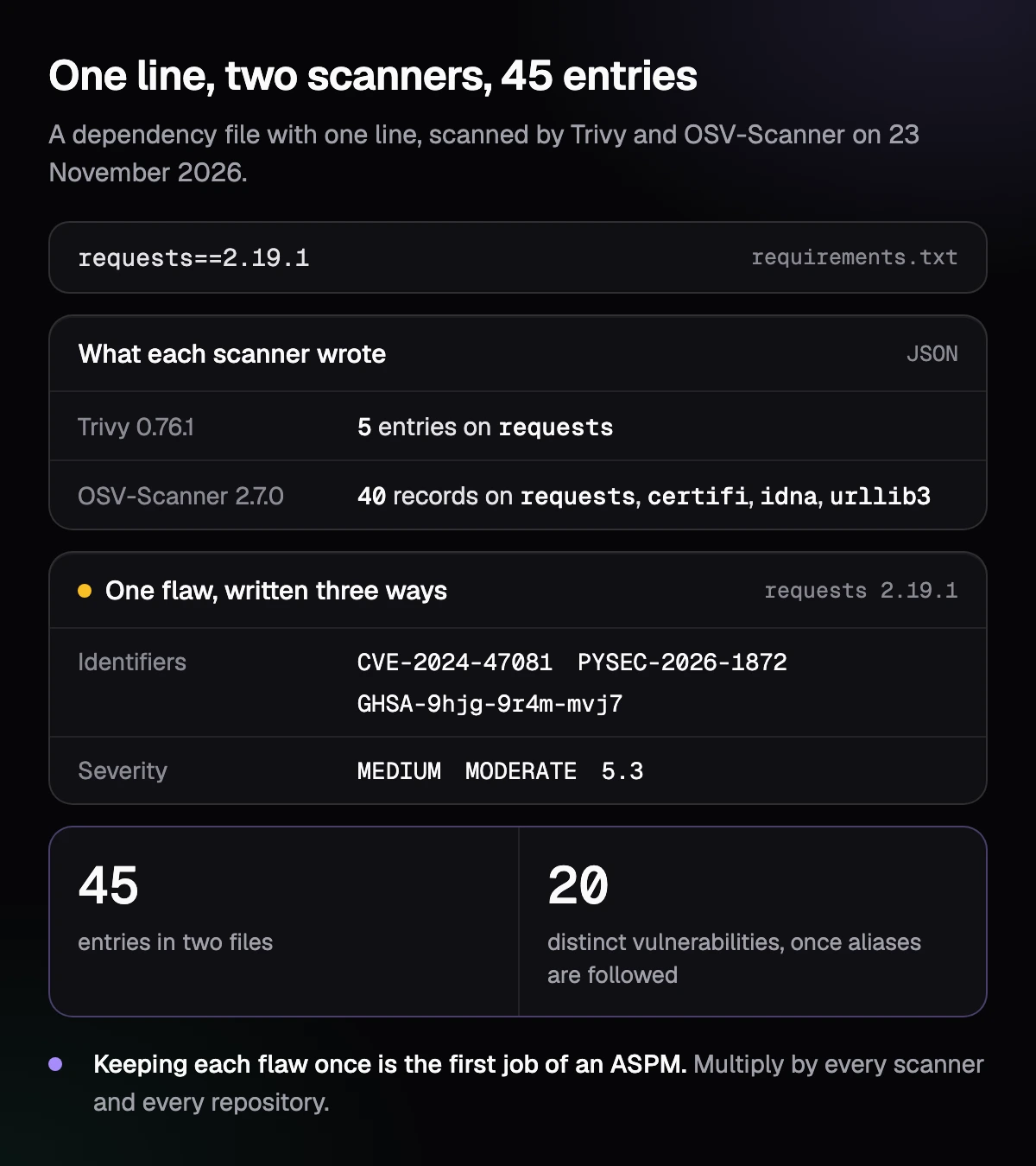
Entries in two JSON files after one scan each of a one-line requirements.txt, on 23 November 2026.
Distinct vulnerabilities behind those 45 entries, once aliases and groups are followed.
Identifiers for the same flaw: CVE-2024-47081, PYSEC-2026-1872 and GHSA-9hjg-9r4m-mvj7.
Entries in five JSON files for 109 distinct vulnerabilities, in our larger test of five open source SCA tools.
That last figure comes from our test of open source SCA tools on one repository, where five scanners on outdated npm, Python, Maven and Go dependencies produced 451 entries with five schemas for 109 distinct vulnerabilities. Add a SAST engine, a secret scanner and a CI scanner, multiply by every repository, and the merging becomes a job. That job is the first half of an ASPM. Our run of six open source secret scanners on one seeded repository shows the same overlap on credentials.
Which open source tools cover which ASPM job?
Every ASPM job has a maintained open source project behind it. The table below was read from each repository and project site on 23 November 2026.
| Tool | Licence | Latest release | ASPM jobs it covers | What it leaves to you |
|---|---|---|---|---|
| CybeDefend Open Source | Open source, launching soon | Waitlist open | Runs the AppSec scanners and an AI scanner run by your coding agent, one deduplicated queue, policy, reports | Watching software outside your repositories, which is OpenCVE's job |
| DefectDojo Community Edition | BSD-3-Clause | 3.5.202, 20 Nov 2026 | Collect (file import or API push), deduplicate, SLA tracking, Jira tickets | Scanning; deduplication across tools is listed as "limited"; EPSS and KEV enrichment and the risk engine sit in the paid Pro edition |
| OWASP Dependency-Track | Apache-2.0 | 5.2.2, 18 Nov 2026 | Component inventory from CycloneDX SBOMs, EPSS ranking, policies that can break the build | Findings from SAST, secret and CI scanners |
| SecObserve | BSD-3-Clause | 1.66.0, 21 Nov 2026 | Upload from open source scanners in CI, rule-based triage, risk acceptance, licence management | Flaws that no scanner reports |
| Faraday Community | GPL-3.0 | 5.25.4, 29 Oct 2026 | Aggregate and normalize the output of security tools, views for analysts and managers | Deduplication, SLAs and ticketing, which its README does not describe |
| GUAC (OpenSSF) | Apache-2.0 | 1.1.0, 13 Mar 2026 | Correlate SBOMs, OSV, Scorecard, SLSA and VEX documents in a graph you can query | Code findings and triage: it is a supply chain graph, not a register |
| ArcherySec | GPL-3.0 | 2.0.6, 31 May 2024 | Correlation, prioritization, Jira, build gating, by its README | Maintenance: last commit on 8 October 2024 |
| OpenCVE | Business Source License 1.1 | 3.1.0, 14 Aug 2026 | Watch new CVEs by vendor and product, filter on KEV and EPSS, alerts | Reading your code or your lockfiles |
DefectDojo: the register a search finds first
DefectDojo is the first name a search for open source ASPM returns, and its README uses the word. Its own pricing page states the fact that matters: "DefectDojo doesn't scan. It manages findings from the scanners you already run". The Community Edition, under BSD-3-Clause, imports the reports of the major open source scanners by file or API push, removes duplicates, tracks status and SLAs, and syncs with Jira in both directions.
The edges are written on that same pricing page. Deduplication in the Community Edition works "Within a scanner; limited across", against "Across your entire stack" in Pro. EPSS and CISA KEV enrichment, the tunable risk engine and the scheduled connectors to other platforms are listed under DefectDojo Pro, and the README states that "SSO (SAML, OIDC, OAuth), LDAP, and MFA are DefectDojo Pro features." So the free edition is a solid register you feed, and the cross-tool correlation our run calls for is the paid part.
OWASP Dependency-Track: components, SBOMs and EPSS
OWASP Dependency-Track, Apache-2.0, works from Software Bills of Materials. It ingests CycloneDX SBOMs and tracks "libraries, containers, operating systems, firmware, and services across every version of every project in your portfolio", in its own words. It matches every component against several vulnerability sources and lets you "prioritize what matters with EPSS", and version 5 brings an expression-based policy engine that can "break the build on a fail". It is the strongest open source answer to the correlate and prioritize jobs, for dependencies. It does not hold your SAST, secret or CI findings, so it sits next to a register. Its README also says version 4 reaches end of life in December 2026, so a new install starts on version 5.
SecObserve: a register built for CI
SecObserve, BSD-3-Clause, describes itself as "an open source vulnerability and license management system for software development teams and cloud environments." Its GitHub and GitLab templates run the scanner and upload the results, and "automatically executed rules and manual assessments" sort out irrelevant results and record accepted risks. It started at MaibornWolff and is now funded through the NGI0 Commons Fund. For a team that wants a register wired into CI with little setup, it is a serious alternative to DefectDojo.
Faraday, ArcherySec and GUAC
Faraday's Community edition, GPL-3.0, "aggregates and normalizes the data you load" from its plugins for security tools, with views its README describes as useful "to managers and analysts alike"; it says nothing of deduplication, SLAs or tickets. ArcherySec, GPL-3.0, calls itself an ASPM on GitHub, but its last release dates from May 2024 and its README warns "DO NOT EXPOSE PUBLICLY, INTERNAL USE ONLY". GUAC, an OpenSSF incubating project under Apache-2.0, "aggregates software security metadata into a high fidelity graph database": SBOMs, OSV, Scorecard, SLSA and VEX documents, queryable for audit and policy. For the supply chain it is the correlation engine to watch, and it leaves code findings and triage to other tools.
Prioritization data: EPSS, KEV and OpenCVE
Two free public feeds do much of the prioritize job. EPSS, from FIRST, is "a data-driven machine-learning model that estimates the probability that a published CVE will be exploited in the wild in the next 30 days." The CISA Known Exploited Vulnerabilities catalog lists the flaws already exploited, and CISA writes that organizations "should use the KEV catalog as an input to their vulnerability management prioritization framework." Join both to your findings by CVE and a medium in a package attackers exploit today moves above a high with no known exploitation.
OpenCVE covers the watch between two scans. It "aggregates vulnerabilities from multiple sources (MITRE, NVD, RedHat, Vulnrichment...)" and lets you filter CVEs "by vendor, product, CVSS, KEV, EPSS, CWE", with alerts by email or webhook and daily reports by project. That matters for the software no repository scan reads: the database engine, the VPN, the CI runner. OpenCVE runs as a hosted cloud with a free plan, or as a self-hosted Community edition under the Business Source License.
What can a team run itself?
A team with a platform engineer can assemble a working open source ASPM, and the shape is always the same: scanners in CI, a register, a component inventory and the public risk feeds.
The scanners are covered tool by tool in our guides to open source SAST tools, SCA tools and secret scanners, and zizmor audits GitHub Actions workflows. If you are leaving a commercial suite, our map of open source Snyk alternatives, product by product gives the replacement for each scanner. The tools are free. What the team owns is the work between them:
The glue
One CI job per scanner and per repository, one import per file, and parsers kept in step when a scanner changes its output.
The triage
Someone decides every week what is real, merges what the register did not, and closes what was fixed.
The policy
Severities, deadlines and exceptions written down, then enforced in the pipeline, not left in a document.
The upgrades
Every scanner, the register and the inventory ship their own releases, and each one needs testing before it reaches CI.
That trade is often right for a few repositories and one engineer who owns it. It gets harder as repositories multiply and the pace of change goes up, because every week without triage leaves the register further from what is really open.
Where does an open source ASPM stop?
An assembled stack covers collection and a register well. It stops in four places.
- Correlation across tools. Our run produced one flaw under three identifiers. Following aliases across scanners and across repositories is the work DefectDojo lists as "limited" in its free edition, and that you script yourself elsewhere.
- Prioritization in context. EPSS and KEV are free, but joining them to every finding, then weighing whether the vulnerable code is reachable and the application exposed, is code you write and maintain.
- Access and identity. Single sign-on, LDAP and MFA are paid features in DefectDojo, which matters once more than one team reads the register.
- The flaws no scanner reports. Every tool in this guide ranks what scanners found. A missing ownership check, a coupon that applies twice, an invoice any logged-in user can read: these are business logic flaws. Pattern scanners walk past them, so an ASPM built on scanners never sees them.
Commercial ASPM platforms, ArmorCode, Apiiro, Cycode, OX Security, Aikido, Checkmarx and Snyk among them, sell answers to the first three gaps as a hosted service: connectors to many tools, context from code to cloud and risk ranking. The fourth gap needs a different kind of scanner.
What changes when coding agents write the code?
Coding agents such as Claude Code, Cursor, GitHub Copilot and OpenAI Codex raise the number of changes per week, so findings arrive faster than a weekly import and triage can absorb. The posture has to move with each change, on the branch, before the merge.
The same agents change what is possible on the finding side. The agent that writes the code can read what the code is meant to do, which is what a business logic flaw needs, and it can write a test that proves the flaw, which is what a register needs to trust it. Our method for finding business logic flaws with your coding agent shows how, step by step.
Where does CybeDefend fit?
CybeDefend Open Source is the open source Snyk alternative, and it is launching soon. It is built for the gaps this guide describes: running the scanners, merging what they find, and going after the flaws they cannot see, in one place. One command in your coding agent, /cybedefend, runs a full audit in two layers.
First the AppSec scanners, open source, with Opengrep, Trivy, Gitleaks and zizmor among them, for code, dependencies, secrets, infrastructure as code, CI/CD and containers. Keep the ones you want and add your own: anything that writes SARIF lands in the same queue. Then the AI scanner, run by your coding agent. Scanners match patterns. The AI scanner reads what your code is meant to do and finds where it breaks, in business logic, in access rights and in the flaws that only show when the code runs, and it proves each flaw with an exploit written as a test. No extra model and no API key: the AI is the coding agent you already run.
Under both layers sits our whole platform, an agentic ASPM, on your own servers: every finding in one deduplicated queue, a policy that blocks the merge on a critical finding, and reports for your auditor. It has no limit on projects or users, and SSO is included. To run it on your own code when it opens, join the CybeDefend Open Source waitlist.
Frequently asked questions
What is ASPM in simple terms?
ASPM, application security posture management, is the layer that collects the findings of all your security scanners, keeps each finding once, ranks them by risk, applies your policy and reports on the result. It finds nothing by itself: it decides what to fix first among what your scanners found.
Is there an open source ASPM?
Yes, in two forms:
- One product: CybeDefend Open Source, launching soon, an open source agentic ASPM you run on your own servers. It runs the open source AppSec scanners and an AI scanner run by your coding agent, and keeps every finding in one deduplicated queue under your policy.
- An assembly of projects: DefectDojo and SecObserve as finding registers, OWASP Dependency-Track for components and EPSS, GUAC for the supply chain graph.
Together, with your scanners and the free EPSS and KEV feeds, the projects of the assembly make a self-hosted ASPM you assemble and maintain.
Is DefectDojo an ASPM?
Its README uses the term. In practice the free Community Edition is a register: it imports findings from other tools, removes duplicates, tracks status and SLAs, and syncs with Jira. It does not scan, and its pricing page lists cross-tool deduplication as limited and places EPSS and KEV enrichment and the risk engine in the paid Pro edition; its README names single sign-on as a Pro feature too.
What is the difference between ASPM and vulnerability management?
Vulnerability management is the loop that tracks each finding to closure: owner, deadline, fix or accepted risk. ASPM includes that loop and adds what comes before it: collecting from every scanner, removing duplicates, correlating with applications and owners, and ranking by risk. Our guide to open source vulnerability management before a SOC 2 or ISO 27001 audit covers the loop as an auditor reads it.
What are the best ASPM tools?
On the commercial side, the buyer's guides and vendor lists we read compare ArmorCode, Apiiro, Cycode, OX Security, Aikido, Checkmarx and Snyk. On the open source side, DefectDojo, SecObserve and OWASP Dependency-Track, with your own scanners under them. CybeDefend Open Source, launching soon, is the open source ASPM in this list that also runs the scanners and an AI scanner run by your coding agent, with one deduplicated queue behind one command.
Does an ASPM find vulnerabilities?
No. An ASPM works on the output of scanners: SAST, SCA, secret scanning, infrastructure as code and containers. Whatever those scanners cannot see, such as business logic flaws and broken access rights, never reaches the ASPM. That is why CybeDefend adds the AI scanner, run by your coding agent, under its queue.
Is CybeDefend open source?
Its open source edition, CybeDefend Open Source, is launching soon: our whole platform, an agentic ASPM, to run on your own servers. The command /cybedefend chains the open source AppSec scanners and an AI scanner run by your coding agent, and keeps every finding in one queue under your policy. Join the CybeDefend Open Source waitlist.