


On this page
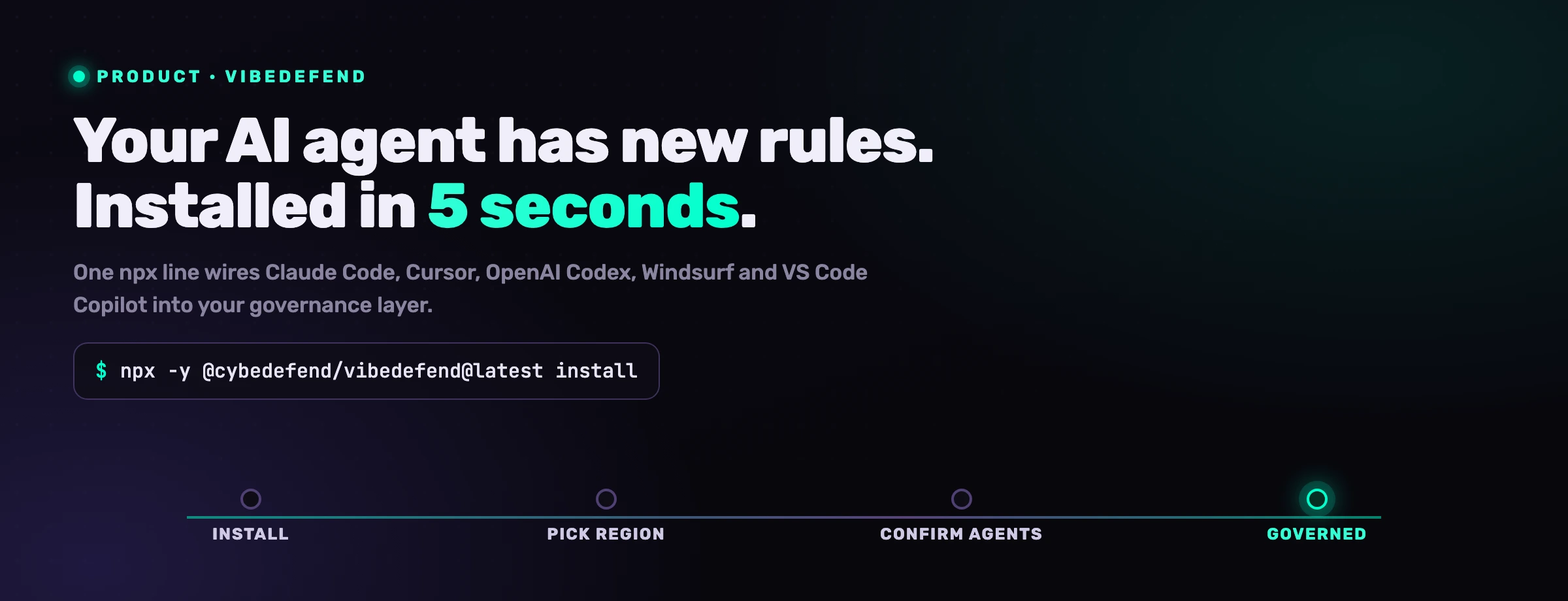
Your AI coding agent ships more code in one day than your reviewers will read in a month. We just shipped the tool that gives that agent your business rules, your security frameworks, and your hard-stop action list. Installed in one command.
@cybedefend landed on npm yesterday. It is a single npx line that auto-detects every coding agent on your laptop and wires them into the CybeDefend governance layer. No yaml. No deploy. No container to build. Run it, pick your region, pick your agents, and your next prompt is already governed.
This post explains what the package does, why it ships now, and how to get from npm to a protected prompt.
The control point moved. Almost nobody noticed.
For fifteen years, AppSec lived inside the pull request. SAST scanned the diff. SCA checked the dependencies. The reviewer read the change. Three layers, all aligned on the same artefact: the PR.
That model assumes one essential thing: that a human reads the diff before it merges. It works at human cadence. It does not work at agent cadence.
When a single developer's Claude Code session ships 2,000 lines of code in an afternoon, the PR-review loop fractures. Some teams just merge. Other teams batch the agent's output into one giant PR that no human actually reads end-to-end. Either way, the diff has stopped being a control point. It is now a transcript.
The new control point is the prompt itself. Whatever rules you want to enforce, you have to put them in the agent's hands before it writes the offending line, not after, in a scanner that arrives once the code is already on disk and the agent has moved on.
That is the entire thesis behind VibeDefend, and it is what shipped yesterday.
What just shipped
VibeDefend is a Node CLI distributed as @cybedefend on npm. It does one thing: it installs the bridge between your coding agent and CybeDefend's governance backend. That bridge has four layers: business rules mined from your repo, security rules from the canonical compliance frameworks, action guards that block dangerous calls before they fire, and live findings that feed every scanner result into the agent.
The installer is a single line.
npx -y @cybedefend/vibedefend@latest install
That is the whole interface. The installer is interactive: it auto-detects which of Claude Code, Cursor, OpenAI Codex, Windsurf and VS Code Copilot live on your machine, asks for your region (EU or US), and writes the MCP wiring, the rule hooks and the doctrine files into the right places.
Node 18.17 is the only requirement. Most readers already have it because Claude Code, Cursor and Codex ship with a bundled Node anyway. Works on macOS, Linux and Windows; bash, zsh, fish, PowerShell, cmd and Git Bash all behave identically.
Four layers of governance, one install
Once VibeDefend is wired, four independent layers start watching the agent. Each layer handles a different threat surface, and each speaks a different shape of rule.
Business Rules
The conventions in your repo that are real but were never written down. Use Decimal128 for money. Never expose a soft-deleted record. Authorisation goes through requireOwner, not raw membership checks. VibeDefend mines them from the way your team already codes, proposes them as explicit rules, and the autopilot keeps mining as you ship. Every accepted rule lands in the agent's context before the next edit.
Security Rules
OWASP Top 10, SOC 2, GDPR, ISO 27001: the playbooks your auditors already expect, loaded the day you install. Add your own custom rules on top. The agent reads every applicable reminder before each edit, so the framework requirement becomes part of the writing instead of a checkbox at audit time.
Action Guard
sudo rm -rf, raw process.env reads on secret-shaped keys, ad-hoc psql statements against production-looking hosts. Action Guard intercepts the agent's call before it fires. Toggle warn or block per rule, add your own forbidden patterns, every interception lands in the audit trail.
Live Findings
Every result from CybeDefend's scanners, SAST with reachability, SCA, secrets, IaC and CI/CD, is live in the agent's context. So the agent does not only write safe code, it triages and fixes the vulnerabilities you already have, each fix a diff you approve.
The point of separating them is that they fail in different ways. A business rule slipping is a quality bug: your code drifts from convention, your team's mental model gets harder to share. A security rule slipping is a compliance bug: you ship something that fails a SOC 2 control. An Action Guard miss is a now bug: the agent just ran something destructive on the machine it had access to. VibeDefend handles all four from the same install.
A concrete pass
Here is what the first session after install looks like in Claude Code.
You ask the agent to add a discount-code feature to the checkout. The agent edits cart-checkout.ts. Before the edit lands, VibeDefend pushes the mined rule no-raw-amount-math from src/billing.ts:14 into the context: "Monetary amounts MUST use Decimal128, never Number." The agent applies it on the very first write (total =) without you having to say a word.
A minute later you ask it to filter the user-search by email. The agent starts to draft db. VibeDefend matches owasp-a03-injection (severity: high) before the line is finished and the agent rewrites with a parameterised query. Again, you said nothing.
Later, while debugging an environment issue, the agent confidently proposes sudo rm -rf . Action Guard blocks it with no-destructive-sudo (severity critical, default-on, cannot be disabled) and the event lands in your CybeDefend audit trail with a timestamp and a reason. The agent gets a friendly refusal; you get a log entry; nothing breaks.
None of these turns were policed by a scanner reading the merged diff. All three were policed at the prompt, by a tool that already had the right rule in hand.
Five agents, auto-detected
The installer covers the five coding agents that hold most of the working market in 2026: Claude Code, Cursor, OpenAI Codex, Windsurf and VS Code Copilot. It detects which ones are installed on your machine and only wires the ones you keep ticked. Re-run the installer any time to toggle an agent on or off; it is idempotent.
The five agents do not expose the same hook surface, so the coverage of each layer differs a little. Claude Code, Cursor and Codex have the deepest integration. Windsurf supports the write-side guards plus a smart fallback for non-write tools. VS Code Copilot ships MCP and the rule layers; Action Guards are still pending on GitHub's side. Re-running the installer pulls in any agent that ships new hook surfaces between releases.
The walkthrough: from signup to a governed prompt
The path from "I saw a tweet about this" to "my agent is governed" takes five steps.
The dashboard lives at eu.cybedefend.com or us.cybedefend.com depending on your region; you pick when you sign up. The free tier exists, no card needed, and includes everything you need to try the four layers end-to-end. The UUID is on the project page once you create one. The .cybedefend is a single-line JSON file you drop at the root of every repo you want monitored:
{ "projectId": "<your-cybedefend-project-uuid>" }
That is the whole onboarding. No SDK to vendor, no Docker image to maintain, no policy DSL to learn. The agent picks up the wiring on the next session start.
Privacy: what reaches CybeDefend, and where it stays
The action guards run on your laptop, next to your agent: whether a command is blocked is decided there, before it runs.
The rest goes through the CybeDefend backend, in the region you picked. To serve the rules that fit the line being written, VibeDefend sends a short excerpt of that code. The scan before the commit sends the changed files. Business rules are mined by the platform from the repository you connect. Your code is never used to train a model, ours or a sub-processor's. The security page says what is kept and where.
EU and US regions are physically separate. Pick the region at install time; the audit trail sits in the region that matches. No replication, no cross-region path. If you need both, you create two projects.
Pricing: free to try
VibeDefend is free to try on your own code: no card, no time limit. For a team, we run a pilot on your repositories, then set a price on your usage. The npm package is BUSL-1.1 licensed and converts to Apache-2.0 on 2030-05-25.
The intent is simple: the friction to put governance inside the agent should be zero. The friction to scale it across an org is where the commercial relationship begins.
What this changes
For ten years AppSec sold scanners that arrived after the code was written. That made sense when humans wrote the code, because humans usually slow down before they merge. That model now lags the workflow by an order of magnitude. The agent ships faster than the scanner cycle, the reviewer reads less than the agent produces, the diff is no longer the gate it once was.
The control point moved to the prompt. The question for every team in 2026 is whether their AppSec stack moved with it, or whether they are still funding tools that police a stage of the pipeline that no longer matters as much.
VibeDefend is the answer we just shipped. It is not the only one possible, and it will not be the last shape the category takes. But it is the first thing we have seen that installs with one command, sits next to every major coding agent, and gives you all four governance layers in one go. That is the bar from now on.
The full package is at npmjs.com/package/@cybedefend/vibedefend. The README and the support matrix live on npm. The product page is at cybedefend.com/vibedefend. The platform is at eu.cybedefend.com and us.cybedefend.com.
Ship a feature this afternoon. See your business rules land in the agent's context. Tell us what we missed.